
Top 10 Remote iPhone & Cloud Phone Platforms 2026
Independent 2026 ranking of the top 10 remote iPhone infrastructure and cloud phone platforms, scored on device realism, isolation, automation, and cost.
Top 10 Remote iPhone Infrastructure / Cloud Phone Platforms in 2026
Two very different products get called a "cloud phone" in 2026. One is a business telephony system that routes calls over the internet. The other is a hosted mobile device — a real or virtual handset you log into remotely to run apps, manage accounts, or test software. This ranking covers the second category only: remote iPhone infrastructure and cloud phone platforms that give you a usable mobile device in a data center.
We scored ten platforms on device realism, isolation quality, automation depth, team controls, latency, and pricing transparency. Every entry below is supported by vendor documentation, published pricing, or independent review evidence. Where a platform sits adjacent to this category rather than inside it, we say so plainly.
How We Ranked These Platforms
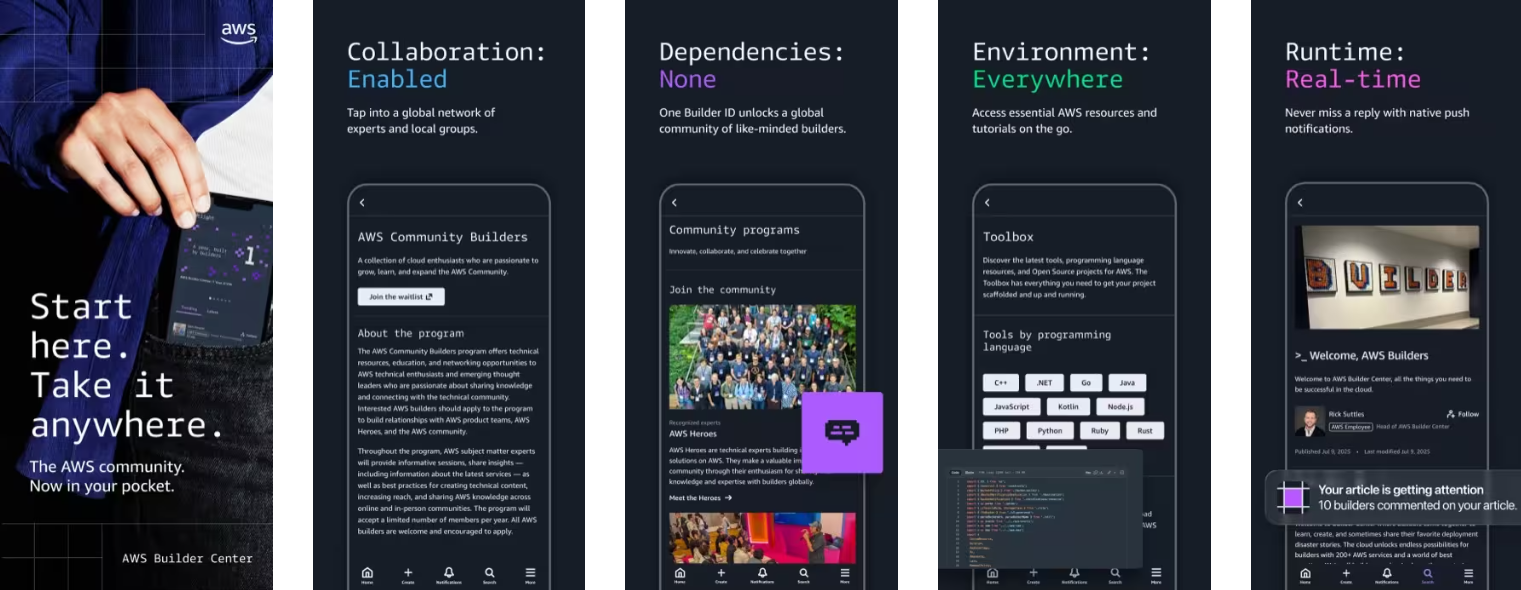
Top 10 Remote iPhone & Cloud Phone Platforms 2026 - Choosing Between Android and iOS Cloud Devices.
No single metric decides a cloud phone purchase. A QA team cares about device authenticity and OS version coverage. A social media agency cares about automation, account isolation, and how many devices it can run at once. We weighted six criteria:
| Criterion | What we checked |
|---|---|
| Device realism | Physical hardware vs. emulator vs. virtualized ARM instance |
| Isolation | Per-device fingerprint, storage, SIM, and GPS separation |
| Automation | API access, bulk actions, scripting, group control |
| Team controls | Multi-user access, permissions, audit trails |
| Performance | Latency, uptime, session stability |
| Pricing clarity | Published rates, setup fees, minimum terms |
We excluded pure VoIP and UCaaS providers. A platform like RingCentral or Dialpad is a cloud telephony system, not a cloud phone device — different buyer, different job. We also excluded browser-only antidetect tools unless they ship an actual mobile device environment.
The Top 10 Remote iPhone & Cloud Phone Platforms for 2026
iRemotech product interface.
1. iRemotech — Best for Real iPhone Infrastructure at Scale
iRemotech hosts physical iPhones in data centers rather than emulating them. That distinction matters: real hardware produces real device behavior, real carrier-backed identity, and app signals that match a genuine handset. Android emulators and simulators cannot fully replicate iOS runtime behavior, which is why teams doing iOS QA or iOS-only social workflows keep running into walls with them.
What it does well
- Dedicated real iPhones, not shared virtual instances
- Remote management dashboard with multi-view device control
- Instagram automations including warm-up, account status checks, and listing
- API access for programmatic control
- Team management and enterprise-grade tooling
Evidence and scale: The platform reports over 6,600 devices deployed, more than 4,500 accounts managed, and over 340,000 automations run per month. Published latency is under 50ms from the EU.
Pricing: From $50 per iPhone per month, no setup fees, cancel anytime.
Best for: Social media agencies, mobile operations teams, iOS QA and app validation teams, security and compliance teams, and enterprises that need dedicated device pools rather than shared capacity.
Watch out for: If your workload is Android-only, you are paying an iOS premium for hardware you will not use.
2. BrowserStack App Live — Best for Cross-Platform QA Coverage
BrowserStack's real device cloud is one of the most established options for manual and automated app testing. It covers a wide matrix of iOS and Android hardware, integrates with CI pipelines, and is built around testing workflows rather than long-running account operations.
Strengths: Broad device matrix, mature automation integrations, strong documentation, and enterprise compliance posture.
Limitations: Sessions are typically time-boxed. It is not designed for persistent, always-on device identity, which is exactly what multi-account operations need.
Best for: QA engineers validating app behavior across many device models.
3. LambdaTest Real Device Cloud — Best for CI-Integrated Mobile Testing
LambdaTest offers real iOS and Android devices with parallel test execution and a strong automation story. Its appeal is speed: spin up many devices at once, run a suite, tear it down.
Strengths: Parallel execution, solid CI/CD hooks, competitive per-parallel-test pricing.
Limitations: Like BrowserStack, it optimizes for test runs, not for maintaining a stable device identity over weeks. Teams running social or commerce accounts need persistence that a test grid does not provide.
Best for: Engineering teams running automated mobile test suites at volume.
4. Sauce Labs Real Device Cloud — Best for Enterprise Test Governance
Sauce Labs has been a fixture in enterprise testing for years, with real device access, detailed reporting, and governance features that satisfy procurement and security review.
Strengths: Enterprise controls, auditability, broad framework support.
Limitations: Pricing is quote-based and skews toward larger contracts. Setup overhead is real if you only need a handful of devices.
Best for: Regulated enterprises with formal test governance requirements.
5. AWS Device Farm — Best for AWS-Native Teams
AWS Device Farm provides real device access inside the AWS ecosystem, which simplifies billing, IAM, and networking for teams already standardized on Amazon's cloud.
Strengths: Native AWS integration, pay-as-you-go model, no separate vendor relationship.
Limitations: The device catalog rotates and is not tailored to social or commerce app workflows. Automation is test-oriented, not operation-oriented.
Best for: Teams whose infrastructure, identity, and billing already live in AWS.
6. Genymotion Cloud — Best for Android Virtualization at Low Cost
Genymotion is a well-known Android virtualization platform available in cloud form. It is fast, scriptable, and cheap relative to physical hardware.
Strengths: Rapid provisioning, strong developer tooling, low entry cost.
Limitations: It is an Android virtual environment, not a real iPhone. If your target is iOS behavior, this is the wrong tool. Even on Android, virtualized environments can diverge from physical device signals.
Best for: Android developers who need fast, disposable test environments.
7. Corellium — Best for Deep iOS Security Research
Corellium virtualizes iOS and Android at a level that supports kernel debugging, vulnerability research, and security analysis. It is a specialist tool, not a general-purpose device cloud.
Strengths: Unmatched depth for security research and reverse engineering.
Limitations: Not built for marketing automation, account management, or app QA at scale. Pricing and onboarding target security teams and researchers.
Best for: Security researchers and red teams working on iOS internals.
8. Mobitru — Best for Small QA Teams Needing Manual Access
Mobitru provides real device access with a straightforward interface, aimed at teams that need manual testing without building infrastructure.
Strengths: Simple onboarding, real devices, reasonable entry pricing.
Limitations: Smaller device catalog than the major grids, and limited automation depth for long-running operations.
Best for: Small QA teams doing manual exploratory testing.
9. TestGrid — Best for Budget-Conscious Device Access
TestGrid offers real device access with a focus on affordability and simplicity. It covers the essentials without the enterprise overhead.
Strengths: Low cost of entry, easy setup, adequate device coverage for common models.
Limitations: Fewer advanced automation features, smaller ecosystem of integrations.
Best for: Startups and independent developers validating apps on real hardware.
10. HeadSpin — Best for Performance and Network Condition Testing
HeadSpin focuses on real-world performance measurement: how an app behaves across networks, geographies, and devices. It combines device access with deep performance analytics.
Strengths: Strong performance telemetry, global device locations, network condition simulation.
Limitations: It is a measurement platform first. If you need persistent device identity for account operations, that is outside its core design.
Best for: Teams optimizing app performance across global network conditions.
Cloud Phone vs. Remote iPhone Infrastructure: What Actually Differs
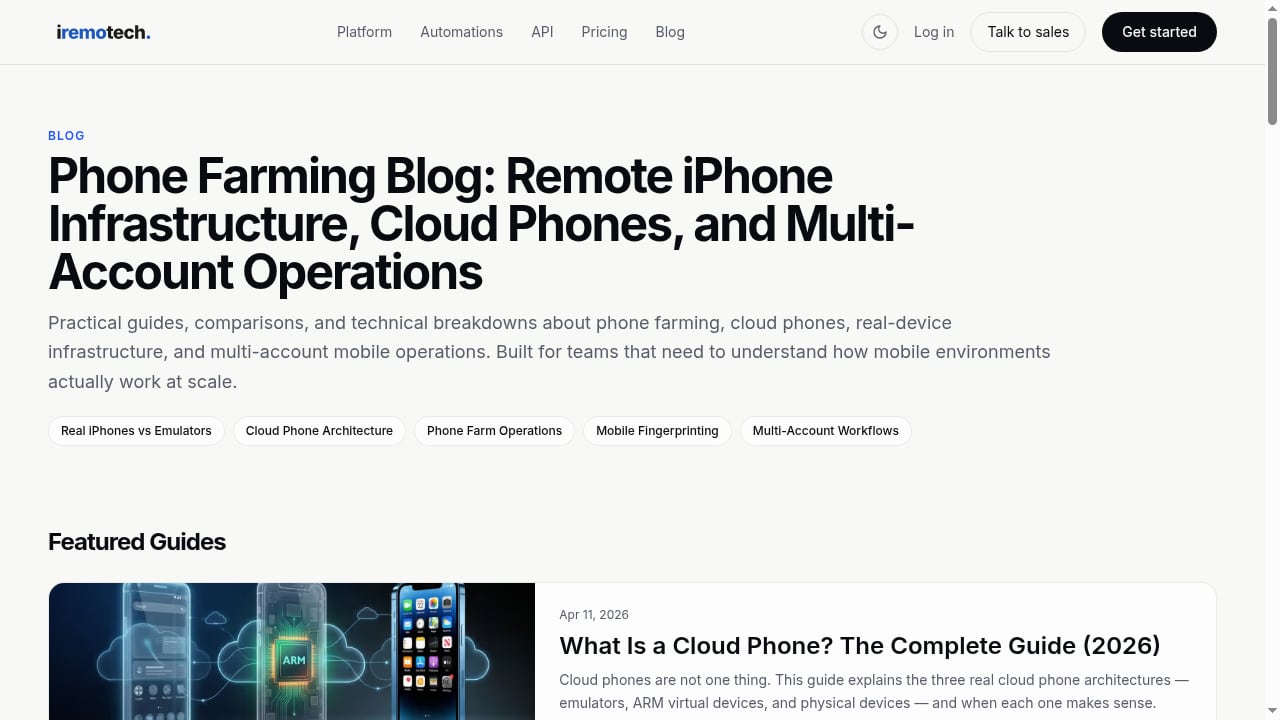
First viewport screenshot of Phone Farming Blog | iRemotech.
The category splits along one axis: what the device is made of.
- Physical iPhones in a data center (iRemotech) — real hardware, real iOS runtime, carrier-backed identity. Best fidelity, highest cost per device.
- Real ARM Android devices in the cloud — genuine mobile hardware running Android, isolated per instance. Strong for Android-first workflows.
- Android emulators and virtualized environments (Genymotion, Corellium) — fast and cheap, but signal divergence is a real risk for account-sensitive work.
- Test grids (BrowserStack, LambdaTest, Sauce Labs, AWS Device Farm) — optimized for short, repeatable test sessions rather than persistent device identity.
If your job is "run this test suite," a test grid is the right purchase. If your job is "keep 200 accounts alive on real iPhones for six months," you need persistent device infrastructure.
Choosing Between Android and iOS Cloud Devices
First viewport screenshot of Use Cases | Agencies, QA, Mobile Ops & Enterprise — iRemotech.
Most cloud phone platforms in the market are Android-first. That is a practical reality: Android is easier to virtualize and cheaper to host at scale. If your operations are Android-centric, an ARM-based Android cloud phone platform is often the more economical choice, and it is worth understanding how isolation and fingerprinting work in that model before you commit.
For a direct comparison of the two hardware philosophies, see DuoPlus Cloud Phone vs iRemotech: Android Cloud vs Real iPhone. If you are evaluating Android options more broadly, the 2026 cloud phone platform review covers ARM fidelity, fingerprint isolation, and group control across ten platforms.
One adjacent workflow worth noting: teams that run Android cloud phones for social or e-commerce often pair them with mobile proxies to keep IP reputation clean. That setup is documented in How to Use DuoPlus Cloud Phone with PROXIES.SX. DuoPlus Cloud Phone is an anti-detect Android cloud phone platform and sits outside this iPhone-focused ranking, but it is a reasonable reference point if your workload is Android and isolation is the priority.
Practical Examples: Matching Platform to Workload
Social media agency running 300 Instagram accounts. Persistent identity, warm-up sequences, and account status monitoring matter more than raw device count. Real iPhone infrastructure with automation APIs fits better than a test grid.
iOS app team shipping weekly. You need many device models, short sessions, and CI integration. A test grid like BrowserStack or LambdaTest is cheaper and faster.
Security team auditing an iOS app. Corellium's depth is the differentiator; general device clouds will not give you kernel-level access.
E-commerce seller managing marketplace accounts. Isolation and fingerprint stability drive the decision. Whether you pick real iOS hardware or ARM Android cloud phones depends on which platform apps you depend on.
Enterprise replacing a legacy device lab. Governance, audit trails, and procurement-friendly contracts push you toward Sauce Labs or a managed real-device provider.
Pricing Reality Check
Published rates vary by an order of magnitude, and the sticker price rarely tells the whole story.
- iRemotech: from $50 per iPhone per month, no setup fees, cancel anytime.
- Test grids: typically billed per parallel session or per device-minute, which is cheap for short runs and expensive for always-on use.
- Virtualization platforms: lowest per-instance cost, but you are trading fidelity for price.
- Enterprise device clouds: quote-based, often with annual commitments.
The trap is comparing a per-minute test price against a per-device monthly price. They are not the same product. Calculate your actual duty cycle first: if a device needs to be online 24/7, monthly device pricing usually wins.
Related reading
- DuoPlus Cloud Phone vs Undetectable.io vs MostLogin - Compare DuoPlus Cloud Phone with Undetectable.io and MostLogin on device realism, mobile app support, isolation, automation, and pricing for multi-accounting.
FAQ
What is remote iPhone infrastructure?
It is a service that hosts physical iPhones in a data center and gives you remote access to them over the internet. You control the device through a dashboard or API, run apps on it, and manage accounts or tests without owning the hardware.
Is a cloud phone the same as cloud telephony?
No. Cloud telephony (RingCentral, Dialpad, Zoom Phone) routes business calls over the internet. A cloud phone platform gives you a mobile device environment. The naming overlap causes constant confusion in procurement.
Can I use Android emulators instead of real iPhones?
For some testing, yes. For account-sensitive operations, emulators carry signal-divergence risk. Real hardware produces authentic device and carrier signals that virtualized environments approximate rather than reproduce.
How much does a remote iPhone cost per month?
Entry pricing for dedicated real iPhone infrastructure starts around $50 per device per month. Test-grid access is billed differently, usually per session or per minute, and can be cheaper for occasional use.
Which platform is best for multi-account social media operations?
It depends on the platform you operate on. iOS-heavy workflows favor real iPhone infrastructure with automation APIs. Android-heavy workflows favor ARM-based Android cloud phones with strong per-device isolation.
Do these platforms support team access?
Most enterprise-grade options do. Look for role-based permissions, shared device pools, and audit logging if more than two people will touch the same devices.
Conclusion
The remote iPhone and cloud phone market in 2026 splits cleanly into two buyer profiles. If you are testing software, pick a real device grid with strong CI integration — BrowserStack, LambdaTest, Sauce Labs, or AWS Device Farm will serve you well. If you are running persistent mobile operations on real hardware, you need dedicated device infrastructure, and iRemotech's physical iPhone model is built precisely for that job.
Before you buy, answer three questions: Do you need iOS or Android? Do you need a device for an hour or a year? And does your workload depend on authentic device signals? Those three answers narrow ten platforms down to two or three very quickly.
For further reading, the 2026 cloud phone platform review covers the Android side of this market in depth, and RoxyBrowser Review 2026 is useful if your workflow also involves desktop browser profiles.
Sources
- The 9 Best Cloud Phone Systems of 2026, Compared — pricing and feature comparison methodology for cloud communication platforms
- Top 9 Cloud Telephony Platforms in 2026 — market sizing and platform feature breakdowns
- The 8 Best Cloud Phone Systems for Small Businesses (2026 selection) — evaluation criteria and user-review scoring approach