
DuoPlus Cloud Phone vs Hidemium vs BitBrowser: 2026 Comparison
Compare DuoPlus Cloud Phone, Hidemium, and BitBrowser for multi-account management. See which fits real Android cloud phones, anti-detect browsing, or automation.

DuoPlus Cloud Phone vs Hidemium vs BitBrowser: Which Multi-Account Tool Fits Your Workflow?
Choosing between a cloud phone platform and an anti-detect browser can feel like comparing two different species of the same animal. DuoPlus Cloud Phone, Hidemium, and BitBrowser all promise safer multi-account management, but they solve the problem at different layers. One runs real Android devices in the cloud; the other two isolate browser profiles on your own machine. This guide breaks down what each tool actually does, where it excels, and how to match it to your specific use case.
Quick Verdict: Three Tools, Three Different Jobs

BitBrowser product interface.
Before diving into details, here is the core distinction:
- DuoPlus Cloud Phone is a cloud-based Android device platform. You are not spoofing a browser; you are controlling a real ARM-based virtual phone with its own Android 15 environment, SIM data, proxy IP, and simulated GPS location.
- Hidemium is an anti-detect browser that creates isolated desktop browser profiles, each with a spoofed fingerprint and optional proxy. It is built for web-based account management and includes a no-code automation node.
- BitBrowser is another anti-detect browser with a generous free tier, RPA automation, team collaboration, and an optional cloud phone add-on called BitCloudPhone.
The right choice depends on whether your accounts live primarily in mobile apps or in web browsers.
What Is DuoPlus Cloud Phone?
DuoPlus Cloud Phone is positioned as the world's first Android 15 anti-detect cloud phone platform. Instead of simulating a browser on your PC, it hosts real ARM-based virtual Android devices in the cloud. Each cloud phone carries a completely independent environment: a unique device fingerprint, globally simulated GPS location, dedicated SIM data, and a proxy IP.
This architecture makes every account appear as though it is running on a separate physical phone in a different location. For marketers running TikTok matrix campaigns, YouTube channel management, Facebook and Instagram ad operations, Telegram growth, or Zalo outreach in Southeast Asia, that mobile-native footprint matters. Many social platforms treat mobile app activity differently from desktop browser activity, and a real Android environment can be harder to flag than a spoofed Chromium profile.
Key DuoPlus capabilities include:
- Unlimited multi-instance support, so you can purchase and control as many cloud phones as needed
- One-click reskin to instantly refresh all device parameters for fast account rotation
- A unified dashboard for team sharing and cross-platform control from any browser or device
- The DUO+ AI Agent, which accepts natural-language commands to automate in-app actions like posting, commenting, or following
Because DuoPlus replaces physical device farms, it is especially relevant for teams that previously maintained shelves of real phones. The value proposition is straightforward: secure, scalable, undetectable multi-account management without hardware overhead.
What Is Hidemium?
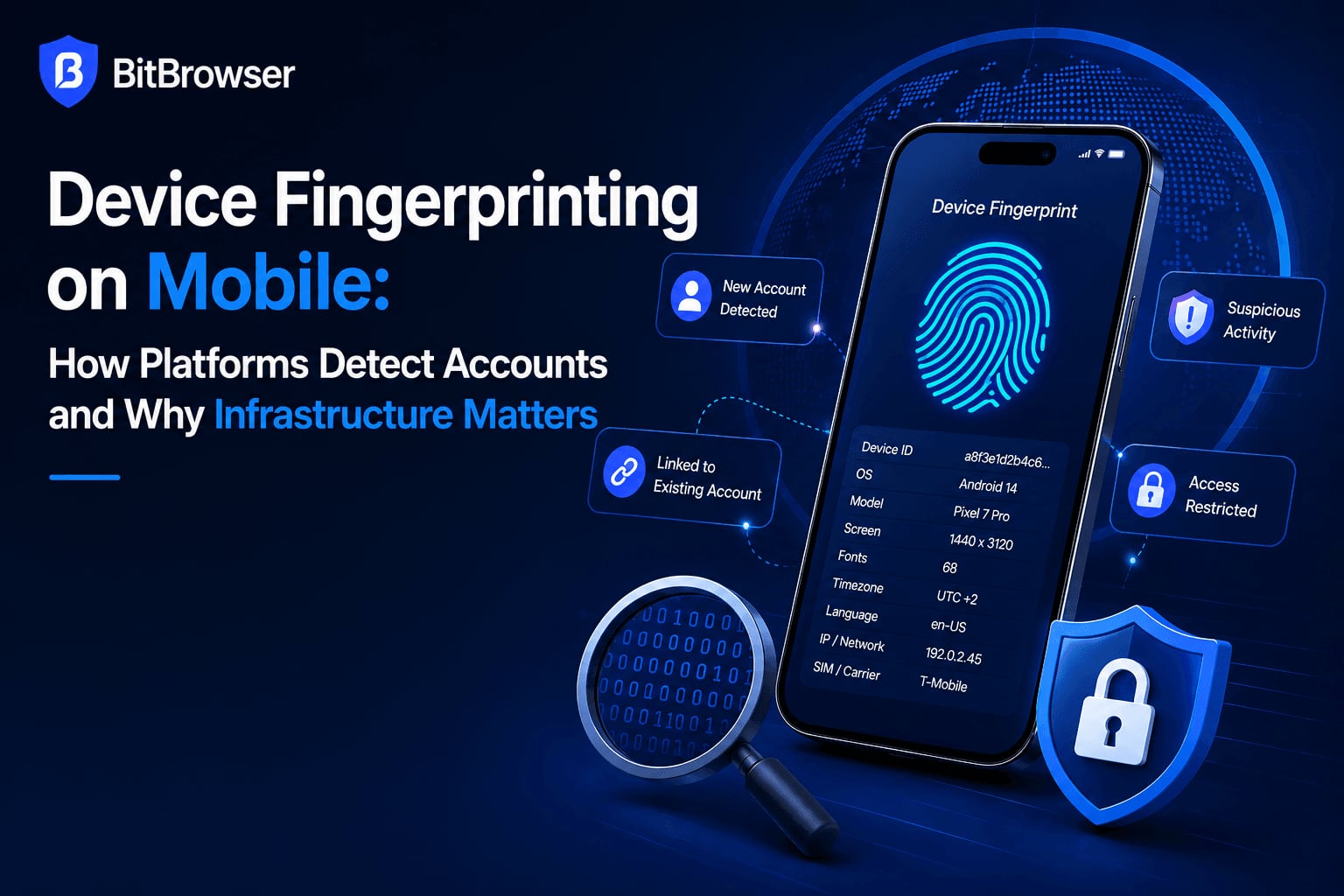
Hidemium is an anti-detect browser aimed at digital marketers, affiliate marketers, e-commerce sellers, and social media managers. It creates isolated browser profiles, each with a unique digital fingerprint covering WebGL, WebRTC, fonts, and other parameters. When paired with a proxy, each profile appears to originate from a separate real user.
Hidemium's strengths are concentrated in the browser layer:
- Fingerprint spoofing across WebGL, WebRTC, fonts, and related signals
- Broad proxy support, including HTTP, SOCKS, IPv6, and residential proxies
- No-code automation through Hidemium AI Node, which translates natural-language instructions into browser task sequences
- Bulk profile creation and cookie import/export for fast account setup
- Campaign management and team collaboration features for agencies and larger operations
Hidemium has earned a 4.9/5 rating and offers a free plan, which lowers the barrier for solo operators testing anti-detect workflows. Its frequent updates, including version 4.3.0, suggest active development. The tool is best suited for web-based multi-accounting: managing multiple social media logins, e-commerce storefronts, ad accounts, and web scraping jobs from one desktop.
What Is BitBrowser?
BitBrowser product interface.
BitBrowser is a free anti-detect browser that simulates more than 20 fingerprint parameters, including WebGL, Canvas, Audio, Timezone, and proxy settings. Its most obvious advantage is pricing: 10 permanent browser profiles are free, which makes it one of the most accessible entry points in the anti-detect browser category.
BitBrowser's feature set includes:
- Team collaboration with permission management, useful for agencies that need controlled access
- Support for all major proxy protocols, including HTTP/HTTPS, SOCKS5, and SSH
- RPA automation for repetitive browser tasks
- An extensions and script marketplace for community-driven tooling
- Data synchronization across devices
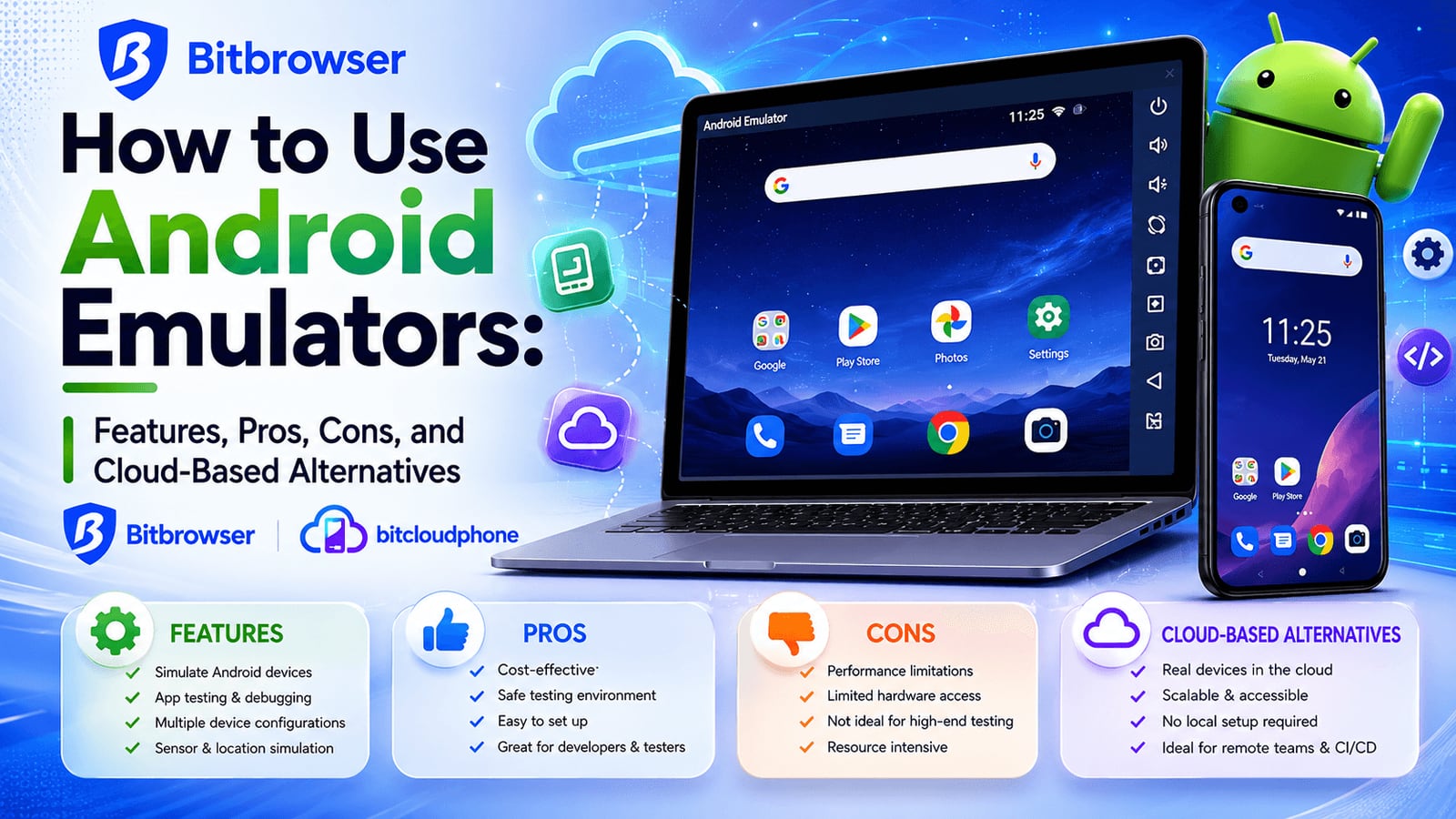
- BitCloudPhone, an Android emulator and iOS cloud phone service for mobile multi-account management
BitBrowser also provides extensive support resources, including video tutorials, community groups on WeChat, Telegram, and WhatsApp, and a help center. Partnerships with proxy providers such as IPDEEP and daily activity rewards add practical value for regular users.
For sellers and marketers who operate primarily on Amazon, Facebook, Instagram, TikTok, and Google Ads through web interfaces, BitBrowser's free tier and RPA automation are compelling. The optional BitCloudPhone add-on extends its reach into mobile app territory, though it is a secondary module rather than the core product.
Head-to-Head Comparison
BitBrowser product interface.
Core Technology: Cloud Phones vs Browser Profiles
The fundamental difference is what each tool actually isolates.
DuoPlus Cloud Phone isolates entire Android operating systems. Each instance is a real ARM-based virtual device with its own SIM data, GPS location, and IP. This is closer to the physical phone farm model, minus the hardware. Hidemium and BitBrowser isolate browser profiles. They spoof fingerprint parameters inside a Chromium-based browser, but the underlying operating system and hardware remain your own.
For mobile-app-first platforms like TikTok, Instagram, or Tinder, a cloud phone can provide a more native footprint. For web-first platforms like Amazon Seller Central, Google Ads, or Facebook Business Manager, a browser profile is often sufficient and faster to spin up.
Automation Approach
All three tools offer automation, but the implementation differs.
DuoPlus uses the DUO+ AI Agent to automate actions inside Android apps through natural-language commands. You can instruct it to post, comment, or follow, and it executes those actions within the cloud phone environment. This is app-level automation on a real Android system.
Hidemium uses its AI Node for no-code browser automation. Users drag, drop, and describe tasks in natural language, and the browser executes them. This is well-suited to web workflows like form filling, content publishing, and data extraction.
BitBrowser offers RPA automation for browser tasks and a script marketplace for community extensions. The RPA layer handles repetitive clicks, navigation, and data entry across profiles.
Team Collaboration
All three platforms support team workflows, but the shape differs.
DuoPlus centralizes account operations in a unified dashboard that supports team sharing and cross-platform control. Team members can access cloud phones from any browser or device without installing local software.
Hidemium includes campaign management and team collaboration features, allowing multiple operators to work across shared profiles with controlled access.
BitBrowser provides team collaboration with granular permission management, which is useful for agencies that need to assign specific profiles to specific staff members.
Pricing and Accessibility
BitBrowser has the strongest free tier: 10 permanent browser profiles at no cost. Hidemium also offers a free plan, though with more limited capacity. DuoPlus Cloud Phone is a paid cloud service, reflecting the infrastructure cost of hosting real Android devices. The trade-off is that DuoPlus eliminates the need to buy physical phones, which can be more expensive than either browser tool over time for mobile-heavy operations.
When to Choose Each Tool

BitBrowser product interface.
Choose DuoPlus Cloud Phone If:
- Your accounts live primarily in mobile apps: TikTok, Instagram, Telegram, Tinder, Zalo, or YouTube mobile
- You need real Android environments rather than spoofed browser fingerprints
- You want to replace a physical device farm with cloud infrastructure
- You need dedicated SIM data and GPS simulation for location-sensitive accounts
- You want app-level automation through natural-language commands
DuoPlus is particularly strong for TikTok matrix marketing and Southeast Asian social platforms, where mobile app behavior is the dominant interaction pattern. For a deeper look at how DuoPlus compares with hybrid anti-detect tools, see DuoPlus Cloud Phone vs BitBrowser vs MoreLogin.
Choose Hidemium If:
- Your accounts are managed through web browsers: Facebook Business Manager, Amazon Seller Central, Google Ads, or affiliate dashboards
- You want no-code browser automation with the AI Node
- You need bulk profile creation and cookie import/export for rapid account setup
- You prefer a free plan to start and scale gradually
- You value frequent updates and a high user rating
Hidemium is a strong fit for affiliate marketers and e-commerce sellers who run dozens of web-based storefronts or ad accounts. For a comparison focused on Hidemium and a hybrid alternative, see DuoPlus Cloud Phone vs Hidemium vs GeeLark.
Choose BitBrowser If:
- You want 10 free permanent profiles to test multi-accounting without upfront cost
- You need RPA automation and a script marketplace for custom workflows
- Your team requires granular permission management
- You operate on Amazon, Facebook, Instagram, TikTok, or Google Ads through web interfaces
- You want the option to add BitCloudPhone later for mobile app accounts
BitBrowser is the most accessible entry point for solo operators and small teams. Its free tier removes the financial risk of trying anti-detect browsing. For a comparison that includes BitBrowser alongside another mobile-first option, see DuoPlus Cloud Phone vs VMOS Cloud vs Nstbrowser.
Practical Example: Scaling a TikTok Operation
Imagine you are running a TikTok matrix with 20 creator accounts targeting three regions. Here is how each tool approaches the problem.
With DuoPlus Cloud Phone, you purchase 20 cloud phones, each with a unique Android fingerprint, dedicated SIM data, and GPS set to the target region. You use the DUO+ AI Agent to automate posting and commenting across all devices. The accounts appear to TikTok as 20 separate physical phones in three different countries. Team members access the dashboard from any browser and manage the fleet collaboratively.
With Hidemium, you create 20 browser profiles, each with a spoofed fingerprint and a residential proxy matching the target region. You use the AI Node to automate web-based TikTok interactions. This works for TikTok's web interface, but the mobile app experience is not replicated. Some TikTok features and trust signals are mobile-only.
With BitBrowser, you create 20 browser profiles using the free tier plus paid additions, attach proxies, and use RPA automation for web-based actions. If you need mobile app behavior, you would add BitCloudPhone instances. The workflow is flexible but split across two modules.
For mobile-first platforms, the cloud phone approach often provides a more complete footprint. For web-first platforms, browser profiles are usually sufficient and more cost-effective.
Practical Example: Managing Amazon Seller Accounts
Now consider an e-commerce operator managing five Amazon seller accounts.
With Hidemium or BitBrowser, you create five isolated browser profiles, each with a unique fingerprint and a dedicated proxy. You log into Seller Central in each profile and manage inventory, pricing, and ads. RPA automation can handle repetitive tasks like order tracking or price updates. This is the standard anti-detect browser workflow, and it works well for Amazon's web interface.
With DuoPlus Cloud Phone, you would use cloud phones to access the Amazon Seller app or mobile web. This is useful if you need to verify account actions through the mobile app or manage accounts that require mobile-specific verification. However, for day-to-day Seller Central work, a browser profile is often more practical.
This example illustrates a key principle: match the tool to the platform's primary interface. Amazon is web-first, so browser tools shine. TikTok and Instagram are mobile-first, so cloud phones have the edge.
Limitations to Consider
No tool is perfect, and honest comparison requires acknowledging trade-offs.
Hidemium and BitBrowser are browser-layer solutions. They do not provide real mobile device environments. If a platform requires mobile app installation, push notification verification, or device-level signals, browser profiles may fall short. Both tools also depend on the quality of your proxies; a weak proxy can undermine even the best fingerprint spoofing.
DuoPlus Cloud Phone is a cloud service with ongoing subscription costs. It is optimized for Android app environments; if your workflow is entirely web-based, a browser tool may be more cost-effective. Cloud phone performance also depends on network latency between your location and the cloud data center.
BitBrowser's BitCloudPhone add-on bridges the mobile gap, but it is a separate module from the core browser product. Users who need deep mobile app integration may find a dedicated cloud phone platform more cohesive.
Related reading
- DuoPlus Cloud Phone vs VMOS Cloud vs SessionBox One - Compare DuoPlus Cloud Phone, VMOS Cloud, and SessionBox One for multi-account management. See which fits real Android cloud phones, automation, or tab isolation.
Sources and further reading
- DuoPlus vs. MoreLogin Comparison - SourceForge - Compare DuoPlus vs. MoreLogin using this comparison chart. Compare price, features, and reviews of the software side-by-side to make the best choice for your business.
- Partners - PrivateProxy.me - Browsers Captcha Traffic Management & Protection Ad-network Agency Ad accounts Push-notifications Browser Fingerprints Review Services
- Our Partners - Integrations & Privacy Tools | LP - LightningProxies - Partnered with the best to offer you the best experience with other tools for online privacy.
FAQ
Can I use DuoPlus Cloud Phone and an anti-detect browser together?
Yes. Many teams use both: cloud phones for mobile app accounts and an anti-detect browser like Hidemium or BitBrowser for web-based accounts. The tools solve complementary problems and can coexist in the same workflow.
Which tool is best for TikTok multi-account management?
DuoPlus Cloud Phone is purpose-built for TikTok matrix marketing. Its real Android 15 environments, dedicated SIM data, and GPS simulation create a mobile-native footprint that is difficult to replicate with a browser profile. Hidemium and BitBrowser can manage TikTok web sessions, but they do not provide the full mobile app environment.
Is BitBrowser really free?
BitBrowser offers 10 permanent browser profiles for free. Additional profiles, team features, and advanced automation may require paid plans. The free tier is a genuine starting point for testing multi-account workflows without upfront cost.
Does Hidemium support mobile app accounts?
Hidemium is a browser-based tool. It does not create Android or iOS environments. For mobile app accounts, you would need a cloud phone platform like DuoPlus or a separate mobile solution.
What is the difference between a cloud phone and an Android emulator?
A cloud phone is a real ARM-based virtual Android device hosted in a remote data center. It has its own SIM data, IP, and GPS. An Android emulator runs on your local computer and shares your hardware, IP, and location unless you add additional masking. Cloud phones provide stronger isolation for multi-account operations.
Which tool is easiest for beginners?
BitBrowser has the lowest barrier to entry thanks to its free tier and extensive video tutorials. Hidemium is also beginner-friendly with its no-code AI Node. DuoPlus Cloud Phone requires understanding cloud phone concepts but removes the complexity of managing physical devices.
Conclusion
DuoPlus Cloud Phone, Hidemium, and BitBrowser occupy different layers of the multi-account management stack. Hidemium and BitBrowser are excellent anti-detect browsers for web-based account operations, with strong automation, team features, and accessible pricing. DuoPlus Cloud Phone is a specialized cloud phone platform for mobile-app-first workflows, offering real Android environments that browser tools cannot replicate.
The decision comes down to where your accounts live. If you manage Amazon storefronts, Google Ads, or Facebook Business Manager through a browser, Hidemium or BitBrowser will serve you well. If you run TikTok matrices, Instagram mobile accounts, Telegram channels, or Southeast Asian social platforms, DuoPlus Cloud Phone's real Android infrastructure is the stronger foundation. Many serious operators use both, pairing a cloud phone platform for mobile apps with an anti-detect browser for web dashboards.
For further comparisons across the broader multi-account tool landscape, explore DuoPlus Cloud Phone vs AdsPower vs Antidetect Cloud and DuoPlus Cloud Phone vs Kameleo vs VMOS.