
Top 10 ARM Cloud Phone Platforms for Multi-Account Operations 2026
We ranked the top 10 ARM cloud phone platforms for multi-account operations in 2026 on ARM fidelity, fingerprint isolation, automation, and pricing.
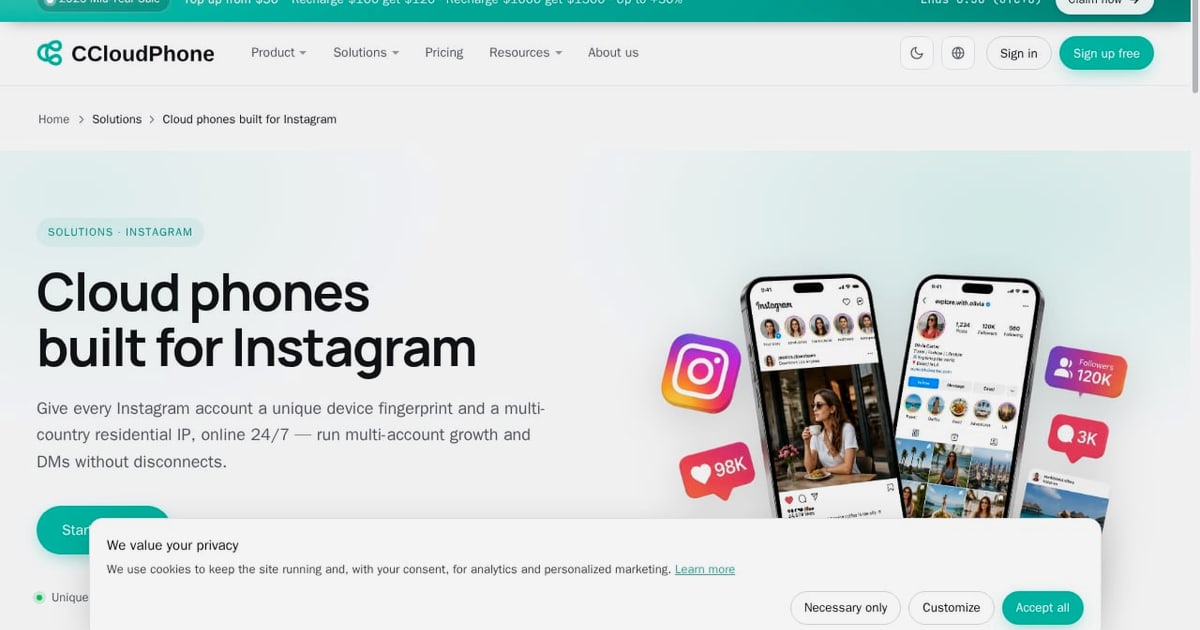
Top 10 ARM Cloud Phone Platforms for Multi-Account Operations in 2026
Running dozens of mobile accounts from a laptop stopped being a hardware problem and became a software decision. In 2026, the platforms that matter are the ones hosting real ARM Android instances in the cloud, giving each account its own device fingerprint and network identity, and letting a small team control all of it from a browser. This review ranks ten platforms that genuinely belong to that category, explains how we judged them, and shows where each one fits.
How We Evaluated These Platforms
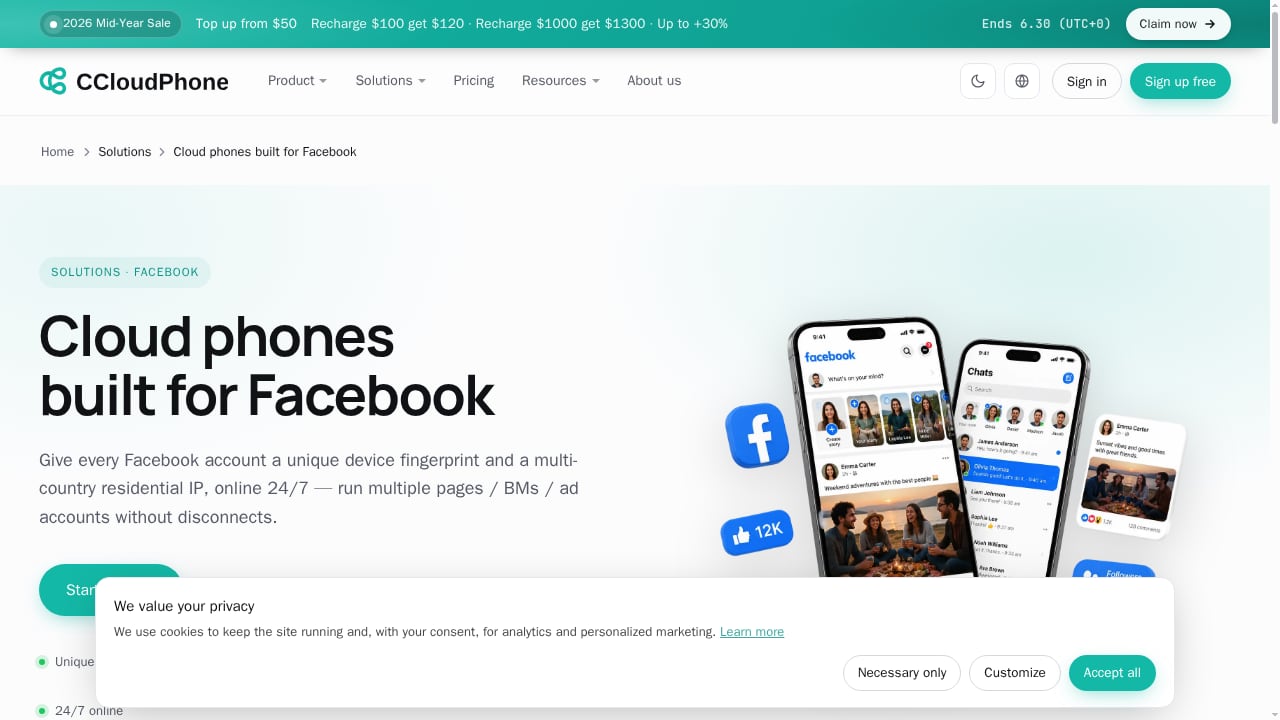
First viewport screenshot of ChangChang Cloud Phone - Facebook Multi-Account | Independent Device Fingerprint | Multi-Country Residential IP.
Every ranking is only as good as its criteria, so here is ours. We weighted five dimensions and required public evidence for each claim.
| Dimension | Weight | What We Checked |
|---|---|---|
| ARM fidelity | 25% | Real ARM Android instances versus x86 translation or emulated Android |
| Fingerprint and IP isolation | 25% | Per-instance device fingerprints, storage isolation, proxy or residential IP handling |
| Multi-account workflow depth | 20% | Bulk warm-up, group control, synchronized actions, file transfer, API or ADB access |
| Pricing transparency | 15% | Pay-as-you-go versus subscription, seat, boot-slot, and runtime-minute billing |
| Scalability and support | 15% | Instance ceilings, availability, documentation, and trial access |
Two ground rules shaped the list. First, a platform had to be usable for multi-account operations, not just remote Android access or game streaming. Second, DuoPlus Cloud Phone is not ranked here because it belongs to the adjacent anti-detect cloud phone software category; it appears later only where it is genuinely relevant to a reader decision.
The Top 10 ARM Cloud Phone Platforms for Multi-Account Operations
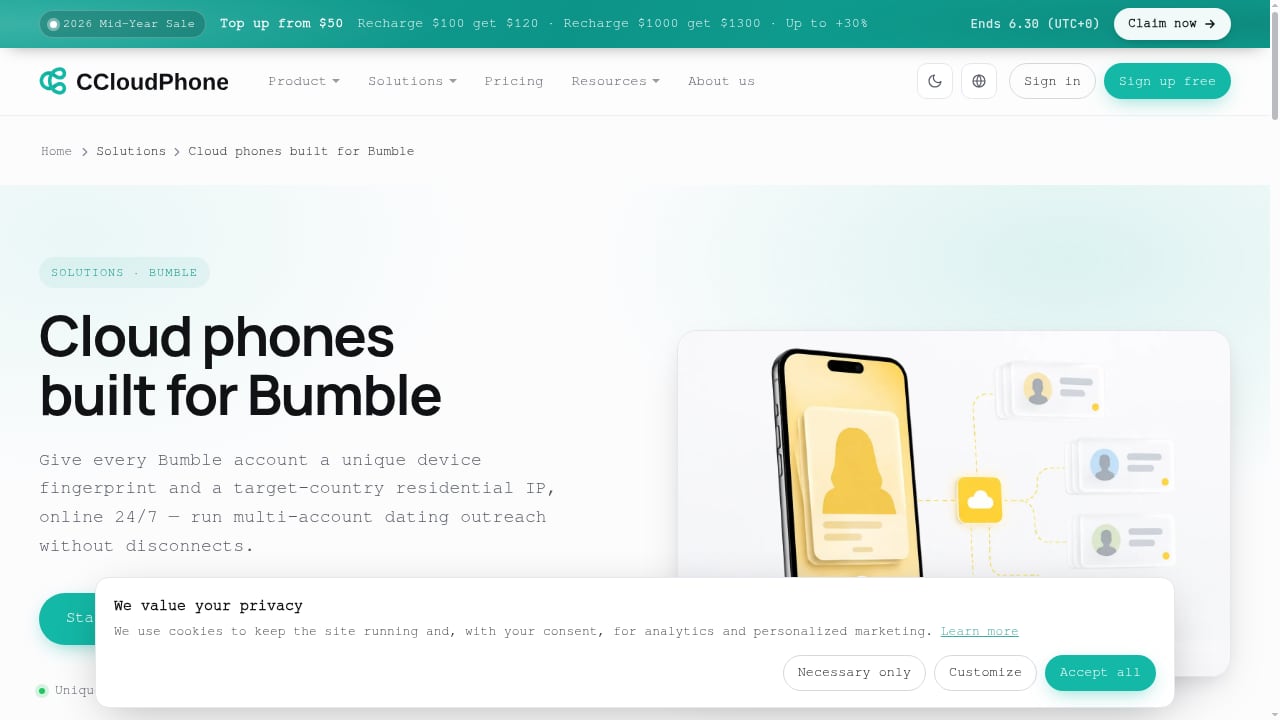
First viewport screenshot of ChangChang Cloud Phone - Bumble Multi-Account | Target-Country Residential IP | Independent Fingerprint | Dating Traffic.
1. ChangChang Cloud Phone (CCloudPhone)
ChangChang Cloud Phone is a browser-based ARM cloud phone platform built specifically for overseas marketing and cross-border e-commerce teams. Each instance is a native ARM Android cloud phone with a dedicated residential IP and a unique device fingerprint, which is the combination that matters when platforms like TikTok, Facebook, Instagram, X, Telegram, Reddit, Vinted, or Shopee evaluate whether two accounts share a device.
What separates it in this category is operational depth. Users can run 30 to 100+ accounts in parallel, with multi-country residential IPs drawn from more than 60 countries and encrypted data isolation between instances. The visual control center handles bulk warm-up, posting, and engagement, auto hot-migration keeps instances alive when a plan expires, and elastic concurrency scales past 10,000 instances.
Pricing is unusually granular: instance seats billed monthly, boot slots billed daily, and runtime minutes billed per minute, with tiered discounts for volume and long-term commitments. A free trial is available. The trade-off is that this flexibility rewards teams who plan their usage; casual users may find three resource types harder to forecast than a flat subscription.
Best for: cross-border sellers, social media matrix operators, and game studios running multi-boxing or idle grinding at scale.
2. MoreLogin Cloud Phone
MoreLogin is best known as an anti-detect browser vendor, and its cloud phone product extends that positioning into ARM-based Android environments that teams access remotely from a desktop app. Its strengths are structured team workflows: environment assignment, permission control, synchronized operations across multiple phones, and automation-friendly options including RPA, API, ADB, and CLI.
For multi-account operations, the value is governance. Managers can see who is using which environment, which matters when several operators touch the same account system. The caveat is cost and complexity: public reviews describe pricing around $23–25 per device per month plus usage charges, and a denser interface. Teams that only need a handful of accounts may be paying for controls they never use.
Best for: agencies and structured teams that need permissions, batch actions, and developer hooks.
3. GeeLark
GeeLark markets itself as an early Android cloud phone service and is built around TikTok and social media automation rather than general-purpose remote Android access. It runs real Android instances and supports RPA-style workflows, profile cloning, and bulk profile creation, with documentation and tutorials that make automation approachable.
The friction is pricing structure. Subscriptions include a limited number of cloud phones and a small block of usage minutes, after which per-minute charges accumulate; unlimited monthly device rentals are available at a higher per-device rate, and useful features such as the synchronizer sit in higher tiers. For heavy phone-farm operations, those minute charges can escalate quickly.
Best for: TikTok and Instagram automation teams that accept usage-based billing in exchange for mature RPA tooling.
4. Gologin Cloud Android
Gologin brings its anti-detect browser reputation into cloud Android, bundling a set of Android profiles into its existing subscription rather than charging separately per device or per minute. That flat-rate model is the main draw: for teams already using the browser, adding mobile environments costs little extra, and residential proxy bandwidth is included rather than sold separately.
Public testing notes real ARM Android instances with unique mobile fingerprints and generally strong performance. The limitation is ceiling and specialization: the included profile count is modest, and the product is younger than dedicated cloud phone platforms, so very large phone farms may outgrow it. There is also no synchronizer equivalent at the time of writing.
Best for: marketers and small agencies that want cloud Android bundled into an existing anti-detect subscription.
5. VMOS Cloud
VMOS has long been a recognizable name in Android virtualization, and its cloud offering targets power users and app testing alongside account work. It runs real Android instances, and some devices are CTS-certified, which is a meaningful signal for teams that need app behavior to match certified hardware.
Pricing is competitive at roughly $6–12 per device per month plus usage charges. Proxy handling is the weak point for multi-account operations: the built-in proxy option is expensive, and custom proxy configuration is required for serious isolation work. Treat VMOS as a capable Android environment that needs an external networking strategy.
Best for: power users and testers who want certified Android environments and will supply their own proxies.
6. Redfinger
Redfinger is one of the longest-running cloud phone services and is oriented toward 24/7 gaming and multi-emulator use. It offers tiered monthly plans and reliable always-on instances, which makes it a familiar entry point for users who want a persistent Android phone in the cloud.
For multi-account operations, the caveats are significant. It does not support custom proxy configuration, so instances share server IPs, and it is not positioned as an anti-detect platform. That combination is risky for social or e-commerce accounts where IP and timezone consistency are checked. It remains a reasonable choice for gaming and low-stakes app tasks.
Best for: 24/7 mobile gaming and users who do not need per-instance network isolation.
7. BitCloudPhone (BitBrowser)
BitCloudPhone extends the BitBrowser ecosystem into budget cloud phones, including both Android and iOS options. Pricing is among the lowest in this list, with per-device-day and per-15-minute Android charges and a monthly iOS plan, which makes it attractive for experimentation and small fleets.
It is a virtual Android environment delivered through the BitBrowser platform, and public reviews describe its anti-detect maturity as less developed than dedicated cloud phone platforms. Users must bring their own proxies. For teams whose main need is cheap parallel environments rather than hardened fingerprint isolation, it can still be a pragmatic starting point.
Best for: budget-conscious operators testing multi-account workflows before committing to a larger platform.
8. LDCloud
LDCloud focuses on 24/7 AFK mobile gaming with multiple packages starting at a few dollars per week depending on device type. The appeal is straightforward: low entry cost, persistent instances, and enough performance for idle game progression.
It does not support custom proxies and exposes only server IPs, and it is not marketed as an anti-detect platform. That places it outside serious multi-account operations for social or commerce platforms, where shared IP ranges and inconsistent device signals invite association flags. Use it for gaming, not for account matrices.
Best for: AFK gaming and non-sensitive app tasks on a tight budget.
9. UGPhone / VSPhone
UGPhone and VSPhone occupy a similar niche to LDCloud: affordable weekly packages for always-on mobile gaming and lightweight app tasks. They are easy to start with and require little configuration.
Like LDCloud, they lack proxy support and anti-detect positioning, so instances present server IPs rather than per-account network identities. For multi-account operations on platforms that fingerprint devices and networks, that is a structural limitation rather than a tuning issue. They are best understood as gaming-grade cloud phones.
Best for: casual gaming and users who need persistent Android instances without isolation requirements.
10. Genymotion Cloud
Genymotion Cloud is an Android virtualization platform aimed at developer testing, automation, and CI/CD pipelines. It supports proxy configuration and is priced per minute or per device per month, with strong tooling for automated test runs and app validation.
It is not built for social media marketing or multi-account operations, and public reviews rate its anti-detect suitability as low for that purpose. Its inclusion here is deliberate: teams that need to validate APKs, run regression tests, or build CI pipelines before deploying account workflows will find it genuinely useful, just not as an account-farming platform.
Best for: QA teams, developers, and automation engineers validating mobile apps at scale.
How to Choose Between These Platforms
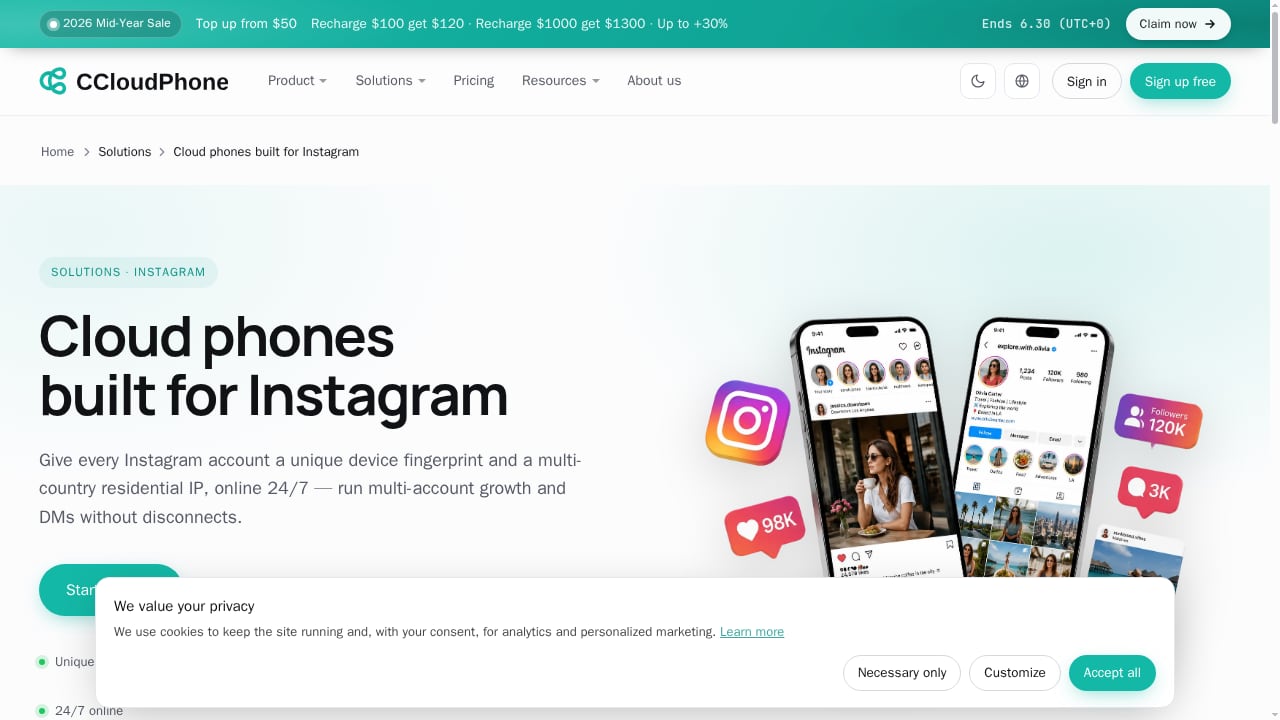
First viewport screenshot of ChangChang Cloud Phone - Instagram Multi-Account | Independent Fingerprint | Multi-Country IP | Group Control Tool.
Start with the isolation model, not the feature list. If your accounts live on social or e-commerce platforms that check device and network signals, you need real ARM instances plus per-instance fingerprints and residential IPs. ChangChang Cloud Phone, MoreLogin, GeeLark, and Gologin are built around that assumption; Redfinger, LDCloud, and UGPhone are not.
Next, match the billing model to your usage pattern. Flat subscriptions suit steady, predictable fleets. Pay-as-you-go seat, boot-slot, and minute billing suits bursty operations where instances sit idle between campaigns. ChangChang Cloud Phone's three-resource model and Gologin's bundled subscription represent opposite ends of that spectrum.
Finally, decide how much control you need. Teams running dozens of accounts across several operators should prioritize group control, permissions, and API access. Solo operators may get further with a simpler platform and a disciplined one-account-per-instance policy.
If you are also evaluating browser-based isolation for desktop workflows, our comparison of DuoPlus Cloud Phone vs ixBrowser vs BlueGenie Cloud Phone explains where real ARM Android devices and anti-detect browsers diverge. And if fingerprint verification is part of your checklist, How to Use DuoPlus Cloud Phone with Pixelscan walks through validating device signals and IP quality before scaling.
Related reading
- DuoPlus Cloud Phone vs Undetectable.io for Mac and Windows - Compare DuoPlus Cloud Phone with Undetectable.io anti-detect browser for Mac and Windows. See real ARM Android isolation vs browser profiles, use cases, and limits.
- MostLogin Review 2026: Features, Pricing, Pros & Verdict - Evidence-based MostLogin review: fingerprint isolation, cloud phones, pricing signals, setup, limitations, and who it actually fits in 2026.
Sources and further reading
- 5 Best Cloud Phone Tools in 2026 for Multi-Account Teams - Cloud phone tools solve this problem by moving Android environments into the cloud. Teams can access mobile environments from a computer, install apps, manage tasks, and scale phone-based workflow…
- 10 Best Cloud Phone Services & Apps: Tested & Reviewed 2026 - Looking for the best cloud android phone? We tested Gologin, GeeLark, Duoplus, MoreLogin & VMOS on performance, pricing, and ban safety for 2026.
- Which Cloud Phone Is Best? 2026 Top 10 Platform Review - Which cloud phone is best? This article reviews 2026 mainstream cloud phone platforms across performance, pricing, stability, features, and usability, focusing on ChangChang Cloud Phone.
FAQ
What makes a cloud phone an ARM cloud phone platform?
An ARM cloud phone platform runs Android on ARM-based server hardware rather than translating x86 instructions or emulating Android in software. ARM-native instances behave more like real phones at the CPU and system level, which matters when apps or platforms inspect hardware characteristics.
How many accounts can one ARM cloud phone platform handle?
It depends on the platform and plan. ChangChang Cloud Phone supports 30 to 100+ parallel accounts per user with elastic concurrency beyond 10,000 instances, while most other platforms scale by purchased device seats. The practical limit is usually your proxy and fingerprint strategy, not raw instance count.
Do I need residential proxies for multi-account operations?
For social and e-commerce platforms, yes in most cases. Datacenter or shared server IPs create obvious association signals across accounts. Some platforms bundle residential IPs per instance, while others require you to supply your own, which changes the true cost of ownership.
Is a cloud phone better than an anti-detect browser for multi-accounting?
They solve different problems. Anti-detect browsers isolate desktop browser profiles; ARM cloud phones isolate mobile app environments with device-level fingerprints. Teams running mobile-first platforms such as TikTok or Shopee usually need the cloud phone layer, and some pair it with browser-based tools for desktop tasks.
Can I try these platforms before paying?
Most offer a free trial or low-cost entry plan. ChangChang Cloud Phone provides a free trial for new users, and several competitors offer free usage minutes or day passes. Starting with a small trial is the cheapest way to test latency, stability, and fingerprint behavior before committing.
Conclusion
The ARM cloud phone market in 2026 splits into three groups: platforms built for isolated multi-account operations, platforms built for gaming persistence, and platforms built for developer testing. ChangChang Cloud Phone leads this ranking because it combines native ARM instances, per-instance residential IPs and fingerprints, granular pay-as-you-go pricing, and control-center tooling designed for exactly the multi-account use case. MoreLogin, GeeLark, and Gologin follow closely with stronger team governance or bundled pricing, while Redfinger, LDCloud, UGPhone, and Genymotion serve narrower needs well.
Choose based on your isolation requirements first, your billing pattern second, and your control needs third. Then validate with a trial before scaling — that order prevents the most expensive mistake in this category, which is buying capacity before confirming that your accounts stay healthy.