
Top 10 Antidetect Browser & Cloud Phone Tools 2026
Ranked 2026 guide to antidetect browsers and cloud phones for multi-account management, with tested criteria, pricing signals, and use-case fit.
Top 10 Antidetect Browser & Cloud Phone Multi-Account Management Software in 2026
Managing many accounts used to mean extra browser tabs. In 2026 it means managing identity: fingerprints, proxies, cookies, device signals, and behavior. Platforms now correlate hundreds of parameters, and one mismatched Canvas hash or timezone can link accounts you spent months warming up.
This guide ranks 10 products that genuinely belong to the antidetect browser and cloud phone multi-account management category. It is written for affiliate marketers, e-commerce sellers, social media agencies, crypto operators, and QA teams who need to run many identities without triggering bans. Every entry includes evidence, pricing signals, and a clear best-fit use case.
How We Evaluated These Products
First viewport screenshot of Best Use Cases For MoreLogin Antidetect Browser..
We ranked tools on six weighted criteria, and we state them openly so you can re-weight them for your own workflow:
- Fingerprint depth (30%): Canvas, WebGL, User-Agent, timezone, fonts, hardware parameters, and WebRTC handling. We reference public benchmarks such as Pixelscan, IPhey, and CreepJS rather than vendor spec sheets.
- Profile isolation (20%): How cleanly cookies, cache, local storage, and sessions are separated per identity.
- Automation and API (20%): REST APIs, Selenium, Puppeteer, Playwright, and no-code RPA for scaling operations.
- Mobile and cloud coverage (10%): Real Android cloud phones versus desktop-only profiles.
- Team and collaboration (10%): Profile sharing, granular permissions, and audit-friendly workflows.
- Value and scalability (10%): Free tiers, per-profile cost at 100 profiles, and update frequency.
One caveat worth repeating: passing a fingerprint checker means the profile holds together, not that you are invisible. A clean residential proxy and human-like behavior decide as much as the browser. For a deeper look at proxy pairing, see our guide on using DuoPlus Cloud Phone with Oxylabs proxies.
The Top 10 Products for 2026
First viewport screenshot of MoreLogin: Cloud Phone & Antidetect Browser for Account Management.
1. Multilogin
Best for: High-stakes teams that want the deepest fingerprint control plus real Android cloud phones in one subscription.
Multilogin remains the depth leader in independent testing. In ScrapingBee's 2026 round, a default macOS profile with a clean residential proxy passed Pixelscan, IPhey, and CreepJS cleanly, with CreepJS reading a genuine Apple GPU at high confidence. It ships two engines (Mimic on Chromium, Stealthfox on Firefox), local and remote APIs, and official Selenium, Puppeteer, and Playwright documentation.
Watch-outs: No free tier. Entry pricing is around $11/month monthly or roughly $7.08/month billed annually for 10 profiles, and team seats start at higher tiers. The API is rate-limited to 50 requests per minute on entry plans.
2. GoLogin
Best for: The best all-rounder and value pick, and the only major provider with a true native Android app.
GoLogin runs on Orbita, its own Chromium fork, and combines desktop profiles with Cloud Browser and Cloud Android options on paid plans. Its free tier is genuine: three profiles with no time limit. Automation support covers a REST API (300–1,200 requests per minute on paid plans), Selenium and Puppeteer guides, and a Browser MCP for driving profiles from AI agents.
Watch-outs: Playwright is CDP-compatible but not officially advertised. iOS is not supported.
3. AdsPower
Best for: Affordable scaling with built-in no-code automation.
AdsPower pairs Sun (Chromium) and Flower (Firefox) engines with a no-code RPA builder, which makes it a strong fit for media buyers who repeat the same actions across dozens of ad accounts. It offers a limited free tier (around two profiles) and competitive annual pricing.
Watch-outs: Independent testing has flagged fingerprint inconsistencies on default profiles in some sessions, so plan to tune settings and verify with your own checker runs before scaling.
4. MoreLogin
Best for: Cross-platform teams that need browser profiles and Android cloud phones in one workspace.
MoreLogin combines isolated browser profiles with customizable fingerprints, cloud Android phones for mobile app workflows, and team collaboration with granular permissions. Standout capabilities include a synchronizer for repeating actions across profiles, no-code RPA workflows, an AI Hub for task assistance, and real canvas fingerprinting. It supports Chrome and Firefox, integrates with Selenium and Puppeteer, and offers a free forever plan with two profiles and two users, with Pro starting around $5.4/month billed yearly for 10 profiles.
Watch-outs: Mobile coverage is narrower than dedicated cloud-phone-first platforms, so heavy Android app farming may need a complementary tool. For a side-by-side view of browser-plus-cloud-phone stacks, see DuoPlus Cloud Phone vs MoreLogin vs MostLogin.
5. GeeLark
Best for: Mobile-first campaigns that need real cloud phones rather than emulation.
GeeLark runs real cloud Android devices with per-device fingerprinting, which matters for TikTok, Shopee, and other app-first platforms where desktop browser profiles look unnatural. Entry pricing starts around $5/month plus usage, with a small free trial.
Watch-outs: Desktop browser profile management is secondary to its mobile focus, so pure web multi-accounting teams may find it less efficient.
6. Dolphin Anty
Best for: Affiliate marketing, media buying, and traffic arbitrage.
Dolphin Anty is built around scenario-based automation and team workflows for ad operations. It offers a free tier of five profiles and pay-as-you-go pricing from around $10/month, which suits freelancers scaling gradually.
Watch-outs: Fingerprint depth is solid but not class-leading; verify against your target platforms before moving high-value accounts.
7. Octo Browser
Best for: Power users and teams that want fast profile creation with real device parameters.
Octo Browser focuses on fingerprint quality and operational speed, with an iOS companion app for monitoring. Pricing starts around €10/month.
Watch-outs: No free tier, and billing is in EUR, which adds currency friction for some buyers.
8. Incogniton
Best for: Solo operators and small teams on a budget.
Incogniton is beginner-friendly, supports Selenium, and offers a free tier of 10 profiles for a limited period before moving to paid plans from around $13.99/month.
Watch-outs: Limited to Windows and macOS, and fingerprint customization is shallower than the top three.
9. Kameleo
Best for: Developers and mobile emulation workflows.
Kameleo supports multiple engines (Chroma, Junglefox) plus Android profiles, making it useful for teams that need both desktop and emulated mobile identities in one tool. Pricing starts around €59/month.
Watch-outs: The highest entry price on this list, and mobile emulation is not the same as a real ARM cloud device.
10. Nstbrowser
Best for: Automation and scraping at scale.
Nstbrowser pairs a Chromium-based antidetect browser with a built-in unblocker and RPA marketplace, and its free tier covers up to 500 profiles, which is unusually generous for testing large automation fleets. Paid plans start around $29.90/month.
Watch-outs: It is optimized for scraping and automation rather than logged-in account nurturing, so social and ad account teams should weigh that trade-off.
Antidetect Browser vs Cloud Phone: Which Do You Need?
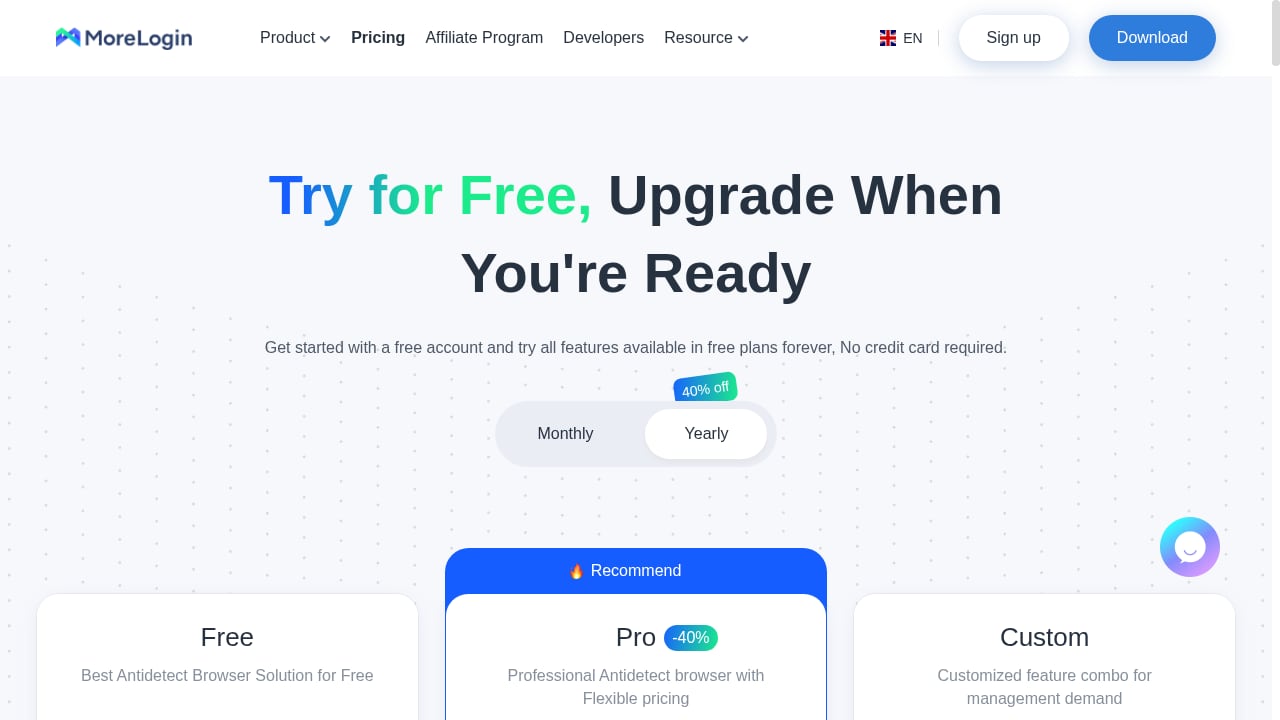
First viewport screenshot of MoreLogin Pricing - Choose the Best Antidetect Browser Package for Your Needs.
The two categories solve related but distinct problems:
| Need | Better fit |
|---|---|
| Web platforms, ad dashboards, marketplaces | Antidetect browser profiles |
| Mobile-only apps (TikTok, Shopee, Lazada) | Cloud phones with real Android devices |
| Scraping and data collection at scale | Browser with strong API and unblocker support |
| Mixed web and mobile fleets | A platform that offers both, or a paired stack |
Many mature teams run both. A browser handles desktop dashboards and marketplace back ends, while a cloud phone handles app-first identities. If your workflow leans mobile, our comparison of DuoPlus Cloud Phone vs GoLogin vs Hidemium walks through where real Android devices outperform browser profiles. DuoPlus Cloud Phone is a dedicated anti-detection cloud phone platform rather than an antidetect browser, so it sits adjacent to this list rather than inside it — useful context if you are assembling a mixed stack.
Practical Setup Tips That Decide Success
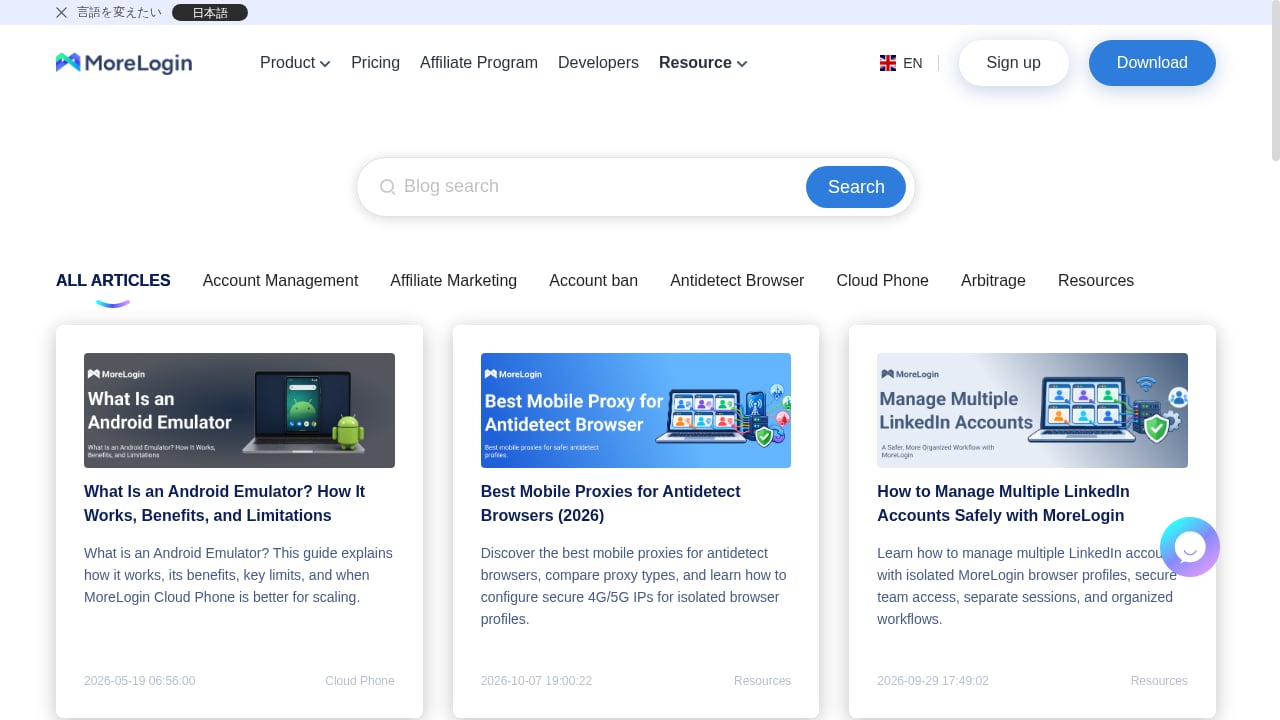
First viewport screenshot of Browser Fingerprints, Useful Tips & Network Security Knowledge Guide | MoreLogin Blog.
- Match proxy geography to profile settings. A US timezone profile should not connect through an unrelated IP. Sticky sessions of up to 24 hours help logged-in profiles stay consistent.
- Run your own checker pass. Test new profiles through Pixelscan, IPhey, and CreepJS before assigning high-value accounts.
- Update frequently. A browser that lags behind Chromium stable releases develops an atypical footprint that detection systems flag.
- Separate behavior, not just fingerprints. Mouse movement, typing rhythm, and session timing still matter after the fingerprint passes.
- Start small, then scale. Warm up a handful of profiles, confirm stability, then expand with automation.
Related reading
- How to Use DuoPlus Cloud Phone with a Free VPN for Open Internet - Learn how to pair DuoPlus Cloud Phone with a free VPN to bypass geo-blocks, protect your traffic, and manage multiple mobile accounts safely.
- DuoPlus Cloud Phone vs BlueGenie Cloud Phone: 2026 In-Depth Comparison - DuoPlus Cloud Phone vs BlueGenie Cloud Phone: Android version, real-device chips, fingerprint isolation, group control efficiency, pricing, and use cases to help you choose the right cloud phone.
- BrowserJet Review: Secure, Fast Proxy Browser Tested - Hands-on BrowserJet review: multi-session browsing, proxy rotation, fingerprint isolation, speed, pricing signals, and who should choose a different tool.
Sources and further reading
- 10 Best Anti-Detect Browsers for Multi-Account Management in 2026 | Live Proxies - Compare the 10 best anti-detect browsers for multi-account management in 2026, including features, pricing, proxies, automation, and mobile support.
- 10 Best Antidetect Browsers in 2026 (Tested + Free Picks) - Multilogin, GoLogin, and AdsPower lead our tested ranking of the best antidetect browsers in 2026, compared on pricing, free plans, and Android support.
- 15 Best Antidetect Browsers in 2026 - Honest Comparison - TL;DR: Antidetect browsers let you run multiple isolated browser profiles, each with a unique fingerprint, so platforms cannot link your accounts. This guide ranks the 15 best antidetect browsers of 2026 across fingerprint quality, automation support, pricing, and proxy integration. We also cover how these tools actually work, when a scraping API is the smarter choice, and which proxy type to pair with each use case.
Frequently Asked Questions
What is the best antidetect browser for multi-account management in 2026?
For high-value accounts, Multilogin leads on fingerprint depth in independent testing. For best overall value with a real free tier and native Android support, GoLogin is the stronger everyday pick. The right answer depends on whether you prioritize fingerprint quality, price, or mobile coverage.
Do antidetect browsers work for mobile apps?
Not directly. Antidetect browsers isolate desktop browser sessions. Mobile-first platforms are better served by cloud phones running real Android devices, such as GeeLark, or by platforms like MoreLogin that bundle browser profiles with cloud Android phones.
Are antidetect browsers legal?
They are legitimate privacy and multi-account management tools. Legality depends on how you use them and on the terms of service of the platforms you access. Always review platform policies before operating multiple accounts.
How much do these tools cost in 2026?
Entry pricing ranges from free tiers (GoLogin, Incogniton, Nstbrowser, MoreLogin) to roughly $5–$12/month for entry paid plans, up to €59/month for developer-focused tools like Kameleo. Per-profile cost at scale matters more than the headline price.
Can I pass fingerprint checks with any of these tools?
Passing Pixelscan, IPhey, or CreepJS means the profile is internally consistent. It does not guarantee you will clear Cloudflare, DataDome, or HUMAN in production. Clean residential proxies and human-like behavior remain decisive.
Conclusion
The 2026 market splits into three practical groups: deep fingerprint platforms for high-stakes accounts (Multilogin, Octo Browser), value-and-coverage all-rounders (GoLogin, AdsPower, MoreLogin), and mobile-first cloud phone tools (GeeLark, and adjacent platforms like DuoPlus Cloud Phone for app-heavy fleets). Pick based on where your accounts actually live — web dashboards, mobile apps, or both — then verify with your own checker runs before scaling. For teams running iOS testing alongside Android fleets, our Top 10 remote iPhone infrastructure products covers the adjacent tooling.