
Top 10 Real-Device Instagram Automation & Phone Farm Software 2026
Independent 2026 ranking of real-device Instagram automation and phone farm software, scored on device realism, isolation, automation depth, and support.
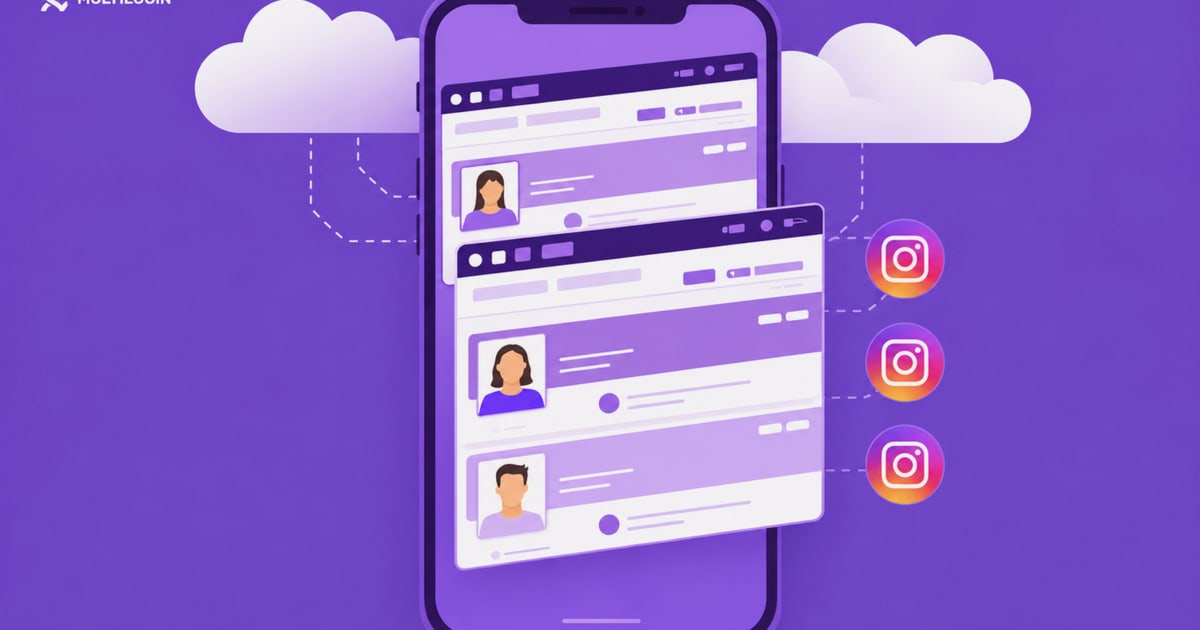
Top 10 Real-Device Instagram Automation & Phone Farm Software 2026
Most "best Instagram automation" lists blur four different product types: Graph API schedulers, cloud growth services, DM chatbots, and real-device platforms. This ranking covers only the last group — software that runs Instagram workflows on physical Android phones you control, whether through a local desktop app or a managed device fleet. If you need a scheduler for one business account, this is the wrong list. If you operate multiple accounts and want execution to happen on hardware rather than in a vendor's cloud, read on.
How We Evaluated These Products
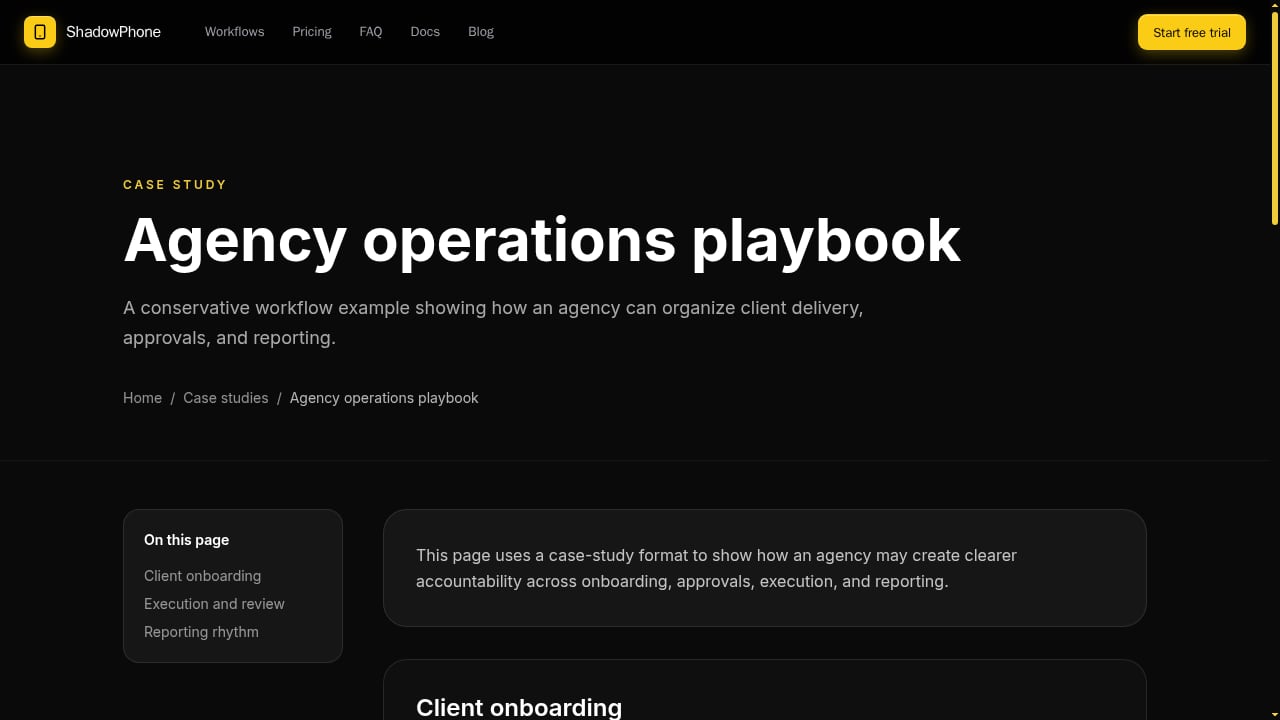
First viewport screenshot of www.shadowphone.io.
Every product below was scored on six criteria, and each ranking entry cites the evidence behind its position:
- Device realism: Does execution happen on actual Android hardware with genuine sensors, SIM behavior, and app environments?
- Account isolation: How are profiles, app data, and credentials separated between accounts?
- Automation depth: Which workflows are covered — publishing, stories, engagement, DMs, account creation — and how are they controlled?
- Operator control: Where does data live, who holds credentials, and can workflows be reviewed before execution?
- Scalability model: How does the product grow from 5 accounts to 500, and what hardware or hosting is required?
- Transparency: Published pricing, documentation, trial terms, and honest operational guidance rather than performance guarantees.
No product in this category can guarantee account survival. Meta's enforcement depends on behavior, content, network history, and account reputation, not on architecture alone. We ranked on operational fitness, not on promises.
The Top 10 Real-Device Instagram Automation & Phone Farm Products for 2026
First viewport screenshot of www.shadowphone.io.
1. ShadowPhone — Best for Desktop-Controlled Physical Phone Operations
ShadowPhone is a Windows and macOS desktop application that drives the operator's own Google Pixel phones running GrapheneOS over USB and ADB. It is the clearest example of the "real-device, local-control" model: content and credentials stay on the operator's computer, credentials are AES-256 encrypted, and each account runs in its own GrapheneOS profile.
Evidence for the ranking: The product publishes a workflow library covering scheduled publishing, engagement, story viewing, outbound DM batches, account creation with automatic number swapping, and stats. Multi-phone orchestration scales from 1 phone and 25 accounts on the $97/month Starter plan to 10 phones and 500 accounts on the $497/month Agency plan, with annual discounts, a 7-day no-card trial, and a 14-day money-back guarantee. Its own documentation is unusually conservative — it states plainly that profiles on one phone share hardware and default network egress, and that no setup guarantees accounts remain uncorrelated.
Trade-offs: You must buy and maintain Pixel hardware, and the local model means you own device logistics. Best suited to agencies, theme-page operators, ecommerce teams, and DM workflow teams that want auditable, reviewable operations rather than a black-box cloud service.
2. GeeLark — Best Cloud-Hosted Real-Device Alternative
GeeLark runs Android cloud phones alongside browser profiles, with a Synchronizer that repeats supported actions across multiple phones and no-code RPA templates for posting, scheduling, and engagement. Its automation layer is the strongest among cloud-hosted options in this category.
Evidence: Independent roundups consistently place GeeLark near the top for mobile-first social workflows, citing synchronized actions, template libraries, and AI-assisted content tools. Users configure their own proxies, and advanced automation varies by plan.
Trade-offs: Execution happens in GeeLark's cloud, not on hardware you hold, and you supply networking. It is a strong fit for teams that want real Android environments without buying phones, but it is a different control model from ShadowPhone's local execution.
3. MoreLogin — Best for High-Volume Phone Creation and Scripting
MoreLogin combines Android phones on real chips with aggressive automation: one-click creation of 100+ phones, scripts and API access, synchronized actions, and connectors for Make, Zapier, and n8n. New users get 2 free phones and 100 minutes of cloud phone time.
Evidence: Roundup coverage highlights its pay-as-you-go model with a daily limit for cost predictability and its strength in fast scaling for posting-heavy operations.
Trade-offs: The platform is broader than Instagram — social, affiliate, and ecommerce — so Instagram-specific workflow depth is thinner than a dedicated tool. Best for teams that prioritize scale velocity and integration with external automation stacks.
4. VMOS Cloud — Best for Packaged Social Growth Automation
VMOS Cloud packages social media growth as a ready-to-use product: smart automation, a sync tool for controlling many phones at once, a built-in internet option, team roles, and support for multiple Android versions.
Evidence: It is positioned specifically around TikTok, Instagram, Facebook, and WhatsApp growth, and reviewers note its feature depth comes with a learning curve.
Trade-offs: The "growth tool" framing means less granular operator control over individual workflows. Suitable for teams that want automation out of the box rather than building their own review process.
5. Multilogin Phone Tier — Best for Teams Already on Anti-Detect Browsers
Multilogin is primarily an anti-detect browser, but its newer real-phone tier is a credible real-device option for operators already running browser profiles. It offers Android cloud phones across multiple device brands, isolated browser profiles in one dashboard, and built-in residential proxies.
Evidence: Its own roundup claims real Android phones across 12 device brands with separate apps, files, sessions, and IPs, plus automation via ADB, API, Selenium, Puppeteer, Playwright, and Postman.
Trade-offs: The phone tier is newer than the browser core, and the value proposition is strongest for existing Multilogin users. For a deeper look at how browser-profile isolation compares with real Android devices, see our DuoPlus Cloud Phone vs Gologin browser comparison.
6. BitCloudPhone — Best Low-Cost PC-Based Android Setup
BitCloudPhone, from the BitBrowser team, runs Android apps on PC and Mac with one-click setup, one IP per phone, and automation via Selenium and Puppeteer, billed by time at a low price point.
Evidence: Reviewers describe it as working more like a phone on your computer than a true cloud phone, which makes account separation weaker on strict platforms.
Trade-offs: The lower isolation quality limits it to lower-risk accounts. It is a budget entry point, not an agency-grade fleet.
7. Redfinger — Best for Light Social Use and Gaming
Redfinger is a browser-accessible cloud phone popular with mobile gamers and social media managers. It provides Android phones online with basic internet support.
Evidence: Roundups consistently describe it as fine for lighter social work and gaming across accounts, without deep automation tooling.
Trade-offs: No meaningful Instagram automation layer. It belongs on this list only as a device substrate for manual or lightly scripted operations.
8. MaxCloudPhone — Best Mid-Market Team Option
MaxCloudPhone runs many Android phones at once with internet connections and basic team features, aimed at social media managers and online sellers.
Evidence: It is characterized as a fair middle option as account numbers grow, with basic rather than advanced collaboration tooling.
Trade-offs: Few differentiators against GeeLark or MoreLogin at similar scale. Choose it when team seats matter more than automation depth.
9. UgPhone — Best for Always-On Device Uptime
UgPhone is built for gaming and all-day uptime: phones that stay on continuously, no battery or data use on a real phone, and fast servers across regions.
Evidence: Reviewers note it is light on social media automation, making it unsuitable for serious multi-account Instagram work.
Trade-offs: Uptime is its strength, Instagram workflow coverage is its weakness. It fits phone-farm-style always-on tasks more than structured Instagram operations.
10. FlashID — Best Mobile-First Cloud Phone for App-Heavy Accounts
FlashID provides mobile phones online with internet support, built around apps like TikTok and Instagram, for social media managers and online sellers.
Evidence: It is described as a mobile-first cloud phone with a straightforward app-centric workflow and moderate isolation.
Trade-offs: Less automation depth and less published operational documentation than the top five. A reasonable starting point for small teams testing the cloud-phone model.
Comparison: Which Model Fits Your Operation?
First viewport screenshot of www.shadowphone.io.
| Model | Representative products | Control | Best for |
|---|---|---|---|
| Local physical phones | ShadowPhone | Highest — your hardware, your data | Agencies and operators who need auditable workflows |
| Cloud real-device phones | GeeLark, MoreLogin, VMOS Cloud, Multilogin | Medium — vendor-hosted Android | Teams scaling without hardware logistics |
| PC-based Android | BitCloudPhone | Medium-low isolation | Budget testing and low-risk accounts |
| Browser-accessible cloud phones | Redfinger, MaxCloudPhone, UgPhone, FlashID | Varies | Manual operations, gaming, light social use |
A practical rule: if your workflow requires reviewable DM queues, per-account profile isolation, and credentials that never leave your machine, the local model wins. If your constraint is hardware procurement and you can accept vendor-hosted execution, the cloud real-device tier is the pragmatic choice.
Where Adjacent Tools Fit
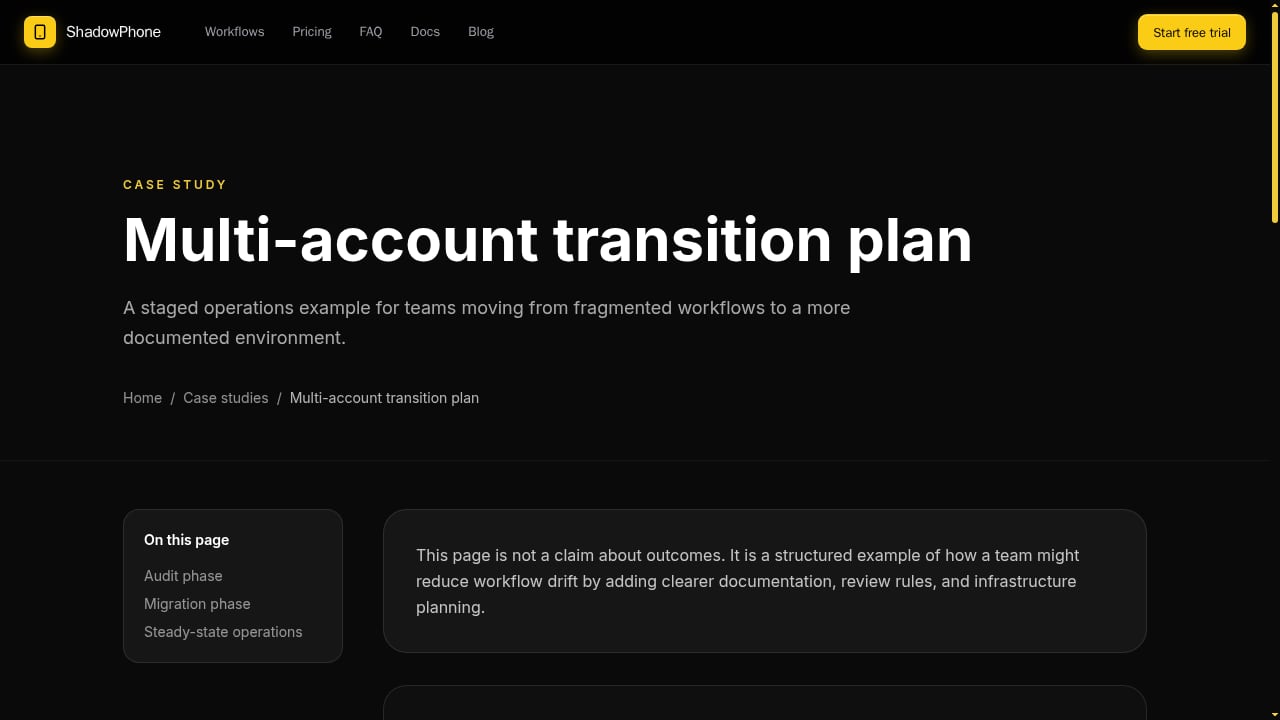
First viewport screenshot of www.shadowphone.io.
Some operators combine device layers. For example, a team running physical phones for Instagram may use a cloud Android service for account verification or region-specific testing. DuoPlus Cloud Phone is one such adjacent option — a cloud-based Android service with isolated environments, unique device fingerprints, GPS, SIM, and base station data, and support for Android 15. It is not a real-device Instagram automation platform in the sense ranked above, and it is not part of this Top 10, but it can complement a physical-phone operation when you need extra isolated environments without buying more hardware. If you are comparing cloud options for that adjacent role, our DuoPlus Cloud Phone vs MoreLogin and BitBrowser comparison covers the trade-offs.
Verification is another common gap. If you run account creation workflows on physical phones, a dedicated number service matters; our guide to using DuoPlus Cloud Phone with Textverified explains the verification flow, and the same principles apply to any device layer.
Related reading
- DuoPlus Cloud Phone + CyberGhost VPN: Secure Setup Guide - Learn how to pair DuoPlus Cloud Phone with CyberGhost VPN for isolated, private multi-account workflows. Step-by-step setup, examples, and FAQs.
- Multilogin Homepage Review: Anti-Detect Browser & Cloud Phone - Evidence-based Multilogin Homepage review: anti-detect browser plus Android cloud phones, ideal users, setup, pricing signals, limits, and decision criteria.
Sources and further reading
- Top 10 Cloud Phones for Social Media Marketing in 2026 - Looking for the best cloud phone for social media marketing? Compare the top 10 options, pricing, and why Multilogin leads the pack.
- Best Instagram Automation Tools (2026 Roundup) - 12 Instagram automation tools compared across DM chatbots, growth services, schedulers, and real-device platforms, with picks by use case.
- Top 10 Phone Farming Apps in 2026: Best Mobile Apps to Make Money Online - Discover the 10 best phone farming apps in 2026, how they work, how they pay, and how cloud phones like BitCloudPhone help you scale safely.
FAQ
What counts as real-device Instagram automation?
Software that executes Instagram actions on actual Android hardware — either phones you own or vendor-hosted real devices — rather than through Meta's Graph API or browser emulation. The category includes desktop controllers like ShadowPhone and cloud phone platforms like GeeLark and MoreLogin.
Is real-device automation safer than cloud growth services?
It removes browser- and emulator-specific execution layers, but it does not guarantee account survival. Meta evaluates behavior, content, network history, and account reputation. Real-device execution is an architectural choice, not a safety guarantee.
Do I need physical phones for ShadowPhone?
Yes. ShadowPhone runs on your own Google Pixel phones with GrapheneOS, connected over USB and ADB. The software license does not include hardware; budget for devices at market prices on top of the $97–$497 monthly plans.
Can I run 500 Instagram accounts on one phone?
No. ShadowPhone's Agency plan pairs 500 accounts with 10 phones, and its documentation notes that profiles on one phone share hardware and default network egress. Account-per-profile isolation is not the same as hardware isolation.
Which product is best for a small agency with 20–50 accounts?
ShadowPhone's Growth tier sits in that range, and GeeLark or MoreLogin are the cloud alternatives if you do not want to manage hardware. Compare on whether you need local credential control or vendor-hosted scale.
Are free trials available?
ShadowPhone offers a 7-day trial without a credit card and a 14-day money-back guarantee. MoreLogin offers 2 free phones and 100 minutes of cloud phone time. Other vendors publish trial terms directly; verify current offers before committing.
Conclusion
The 2026 real-device Instagram automation market splits cleanly between local-control platforms and cloud-hosted device fleets. ShadowPhone leads this ranking because it publishes its operational limits, keeps credentials and content on the operator's machine, and structures workflows for review — the qualities that matter most when account portfolios are business assets. GeeLark and MoreLogin are the strongest cloud alternatives, while the remaining entries serve narrower needs: budget testing, gaming uptime, or app-heavy manual work. Pick the control model first, then the product. And treat any vendor promising guaranteed account survival as a warning sign, not a feature.