
DuoPlus Cloud Phone vs Multilogin vs ShadowPhone (2026)
DuoPlus Cloud Phone vs Multilogin vs ShadowPhone compared for mobile multi-accounting: device realism, scale, automation, isolation, and cost.
DuoPlus Cloud Phone vs Multilogin Homepage vs ShadowPhone
If you manage many mobile accounts, the tool you choose shapes how the work feels. DuoPlus Cloud Phone, Multilogin, and ShadowPhone all promise safer multi-account operations, but they are built on different foundations: cloud-hosted Android devices, a combined browser-plus-cloud-phone workspace, and a desktop app that drives your own physical Pixel phones.
This comparison looks at where each product is genuinely strong, and where the choice comes down to your workflow rather than a single "best" answer.
The three products at a glance
First viewport screenshot of www.shadowphone.io.
| DuoPlus Cloud Phone | Multilogin | ShadowPhone | |
|---|---|---|---|
| Core model | Anti-detect Android cloud phones on real ARM devices | Android cloud phones plus isolated browser profiles | Windows/macOS app controlling your own Pixel phones over USB/ADB |
| Best for | Mobile-first multi-account operations at scale | Teams mixing mobile apps and desktop web accounts | Disciplined, auditable Instagram workflows on real hardware |
| Access | PC and mobile browsers | Desktop application | Desktop application |
| Device environment | Unique fingerprints, GPS, SIM, and base station data | Real device parameters, SIM and network settings | One GrapheneOS profile per account on physical hardware |
| Automation | Built-in RPA, operation sync, API, ADB | API, ADB, Selenium, Puppeteer, Playwright | Scheduled publishing, DM queueing, workflow library |
| Hardware needed | None | None | Google Pixel phones running GrapheneOS |
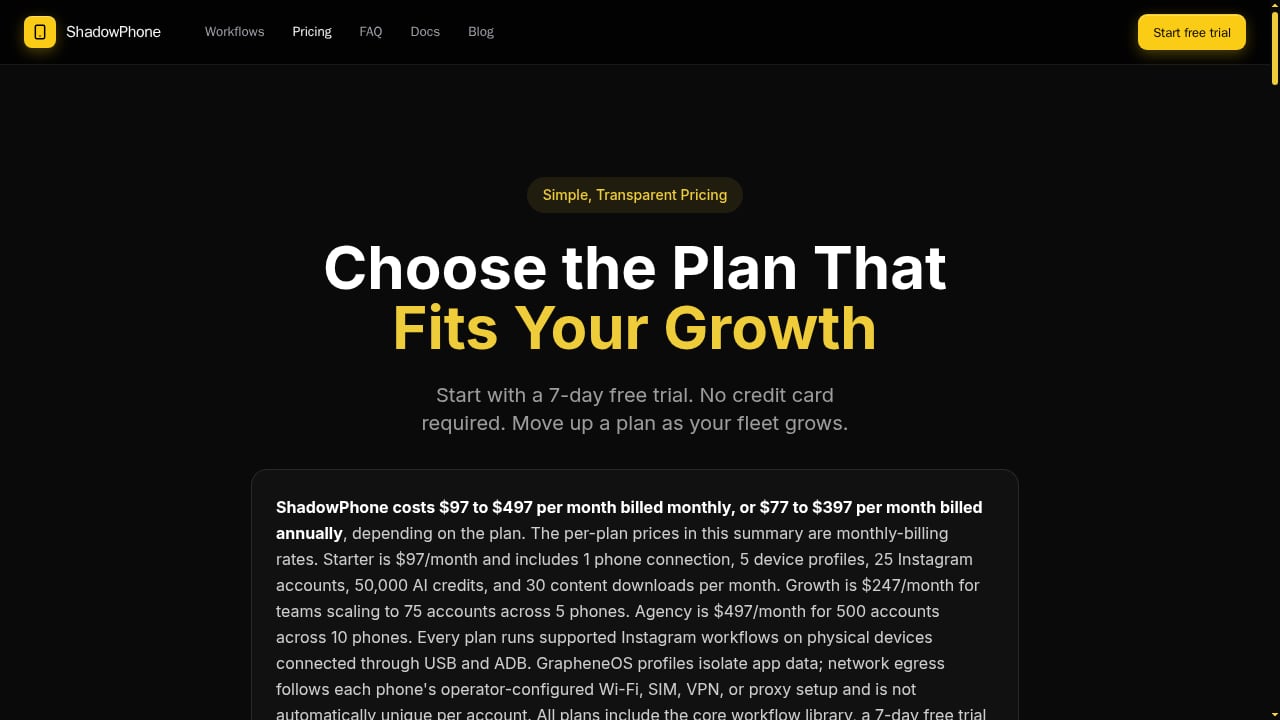
| Pricing entry | Free trial, monthly and annual plans, startup-time packages | Free plan, paid plans from low monthly tiers | $97/mo Starter to $497/mo Agency |
DuoPlus Cloud Phone: cloud phones built for mobile operations
First viewport screenshot of www.shadowphone.io.
DuoPlus is a cloud-based Android phone service. Each environment runs on a real ARM mobile device deployed in a data center, with its own device fingerprint, GPS coordinates, SIM card details, and base station data. You open it in a browser on PC or mobile, so there is no desktop client to install and no hardware to maintain.
That combination matters for social media marketers, e-commerce sellers, affiliate marketers, ad account managers, game farmers, live streamers, and app testers who need many isolated Android environments without buying racks of phones.
Key capabilities include:
- Unlimited device multiplicity with isolated environments per account
- One-click reskin to change a device's environment when a workflow needs a fresh identity
- Bulk app installation and management across phones
- One-click sharing for team collaboration
- Multi-platform control from PC and mobile browsers
- Android 15 support, with DuoPlus positioning itself as the first anti-detect cloud phone and first Android 15 cloud phone
Pricing includes a free trial, monthly and annual plans with volume discounts, and startup-time packages billed by the minute for teams that only need devices part of the day.
For a deeper look at how real ARM devices compare with virtualized Android environments, see DuoPlus Cloud Phone vs VMOS: Real ARM vs Virtualized Android.
Multilogin: one workspace for mobile apps and desktop web
First viewport screenshot of multilogin.com.
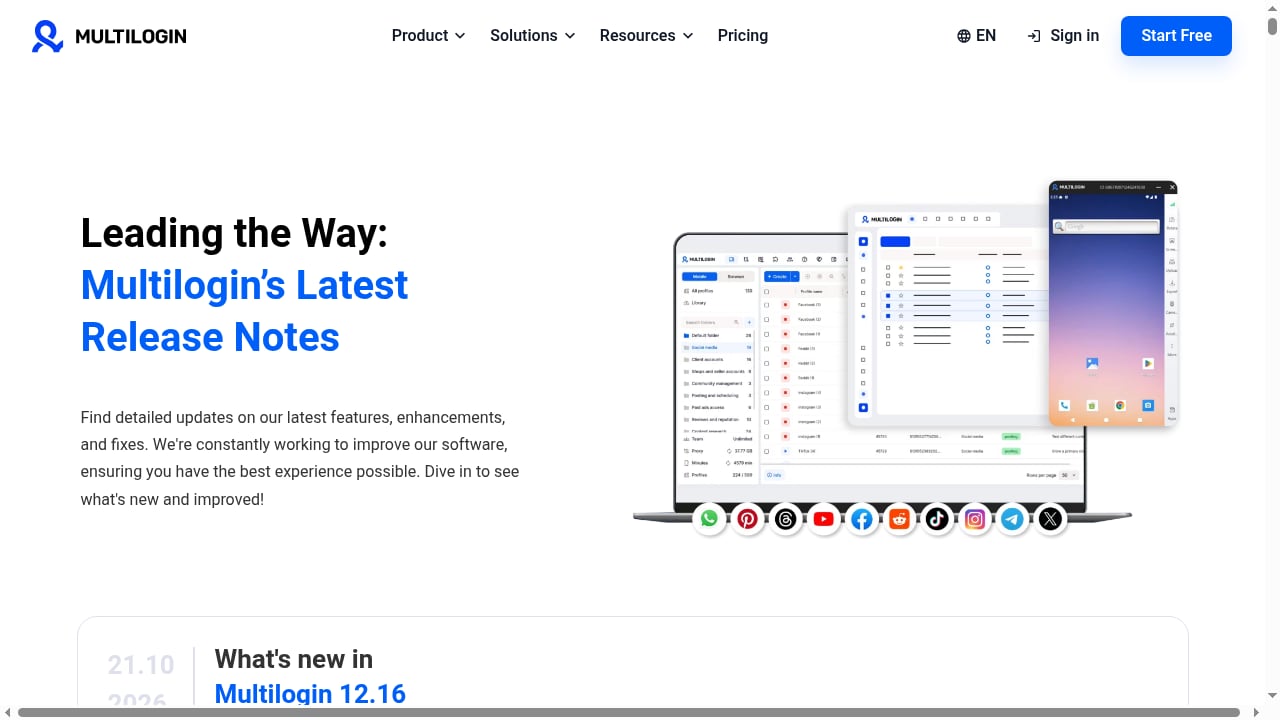
Multilogin is a well-established name in anti-detect browsing, and its cloud phone offering extends that platform into Android apps. Its clearest strength is scope: Android cloud phones and isolated browser profiles live in the same dashboard, with built-in proxy traffic and team controls.
That makes Multilogin a sensible fit when your work crosses both worlds. A team might publish through a mobile app, review analytics in a browser, manage ads through a desktop session, and keep client assets organized in one place. Instead of stitching two tools together, the browser profile and the cloud phone sit side by side.
Other credible strengths:
- Real device parameters across a range of Android brands and versions, so environments look like ordinary consumer phones
- Bundled proxy allowances with residential, ISP, and mobile options, plus support for third-party proxies
- Broad automation support, including API, ADB, Selenium, Puppeteer, Playwright, and Postman
- Structured team features such as profile sharing, folders, permissions, and unlimited seats on higher tiers
- A free plan that lets you test the platform before committing
Multilogin's own comparison pages argue that its all-in-one approach reduces tool sprawl. That is a fair point for web-heavy teams. If your accounts live mostly inside Android apps, though, a browser-first platform may include more surface area than you need.
ShadowPhone: real-device Instagram operations you control
First viewport screenshot of www.shadowphone.io.
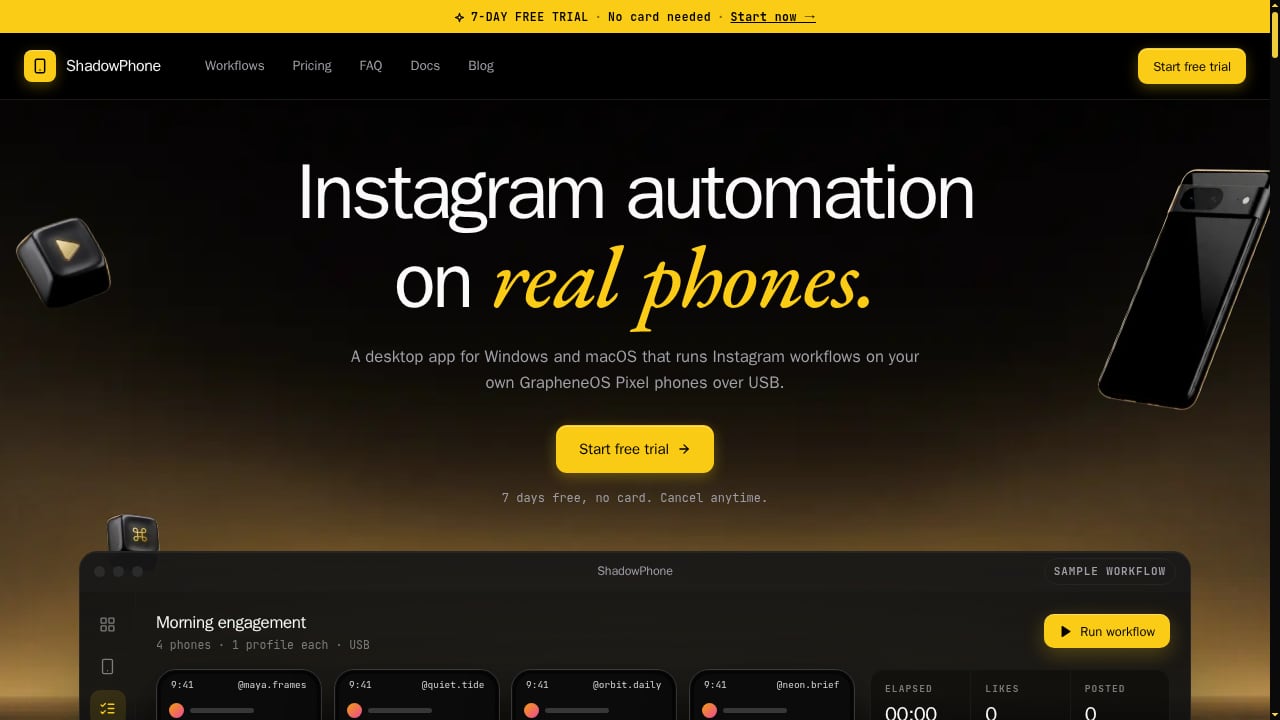
ShadowPhone takes a deliberately different path. It is a desktop application for Windows and macOS that runs Instagram automation on your own Google Pixel phones running GrapheneOS, connected over USB and ADB. Nothing runs in a vendor's cloud; content stays on the operator's computer, credentials are AES-256 encrypted, and each account gets its own GrapheneOS profile.
Its strengths are transparency and discipline:
- Real-device execution on hardware you physically control
- Per-account profile isolation on GrapheneOS
- Structured workflows for scheduled publishing, engagement, stories, DMs, and account creation with automatic number swapping
- Multi-phone orchestration from one desktop app
- A workflow library and conservative operational guidance, with documentation and case studies rather than aggressive performance claims
- A 7-day free trial without a credit card and a 14-day money-back guarantee
Pricing runs from $97/mo for Starter (25 accounts, 1 phone) to $497/mo for Agency (500 accounts, 10 phones), with annual discounts. The product is aimed at Instagram agencies, theme page operators, ecommerce teams, DM workflow teams, and multi-account operators who want reviewable, auditable processes.
The trade-off is built in: ShadowPhone is Instagram-focused, and you supply and maintain the phones. For a team that already owns Pixel hardware and values keeping data local, that is a feature. For a team that needs to scale across platforms and geographies quickly, it is a constraint.
For a direct head-to-head on these two mobile approaches, read DuoPlus Cloud Phone vs ShadowPhone: 2026 Comparison.
Where DuoPlus Cloud Phone stands out
Each product has a defensible position. On the criteria below, DuoPlus Cloud Phone has a supported advantage worth weighing.
Scaling without hardware
DuoPlus deploys real ARM devices globally, so adding environments does not mean buying, charging, cabling, and storing more phones. ShadowPhone's model depends on the Pixel phones you own and connect; scaling past ten phones means more hardware and more physical management. DuoPlus's cloud model removes that ceiling, which suits affiliate marketers, e-commerce sellers, and game farmers who need to grow a device fleet quickly.
Mobile-first depth, not a browser add-on
DuoPlus is built around cloud phones rather than adding them to a browser product. Its toolset reflects that: operation sync across phones, RPA for repeatable mobile tasks, batch app installation, one-click reskin, and live-streaming workflows. For teams whose accounts live in TikTok, Shopee, Lazada, or mobile games, that focus keeps the workflow inside one mobile environment.
Local-looking environments
Each DuoPlus device carries its own fingerprint, GPS, SIM, and base station data. That lets operators simulate a local operational environment, which matters for regional e-commerce, localized app testing, and accounts that need to appear to operate from a specific market.
Flexible cost structure
DuoPlus offers a free trial, monthly and annual plans with volume discounts, and startup-time packages billed by the minute. Teams that only need devices during campaigns can pay for runtime instead of a flat per-account subscription. That flexibility is useful for seasonal sellers and testers whose device needs fluctuate.
Browser-based access
Because DuoPlus runs in PC and mobile browsers, operators are not tied to a desktop client. A team member can check a phone, run a batch task, or share an environment from a laptop or phone.
Where Multilogin and ShadowPhone are the better choice
Honest comparisons include the cases where the alternative wins.
Choose Multilogin if your operation genuinely spans desktop websites and Android apps, and you want browser profiles, cloud phones, and proxy traffic under one subscription with mature team permissions. Its browser heritage is an advantage for web automation and cross-platform social media management.
Choose ShadowPhone if you run Instagram-focused workflows, want execution on physical hardware you control, need credentials and content to stay local, and value auditable, conservative processes over rapid scaling. Its per-account GrapheneOS isolation and workflow library are strong fits for agencies with disciplined review practices.
Decision guide: which fits your workflow?
- You need many Android environments across platforms and regions, without hardware: DuoPlus Cloud Phone.
- You manage both mobile apps and desktop web accounts in one team workspace: Multilogin.
- You run Instagram automation on your own Pixel phones and want data to stay local: ShadowPhone.
- You need short bursts of devices for campaigns or testing: DuoPlus startup-time packages.
- You want a free entry point to test a combined browser and cloud phone platform: Multilogin's free plan.
- You want a no-credit-card trial of a real-device Instagram workflow: ShadowPhone's 7-day trial.
No tool guarantees account survival. Platform rules, content quality, access patterns, and operator behavior all influence outcomes. The right choice is the one whose architecture matches how your team actually works.
If you are still mapping the category, Top 10 Cloud Phone & Android Emulator Software 2026 and Top 10 Anti-Detect Browser & Cloud Phone Products 2026 provide broader context.
Related reading
- iRemotech Review 2026: Real iPhone Cloud for Mobile Ops - Evidence-based iRemotech review: real cloud iPhones for Instagram automation, QA, and device fleets. Pricing, setup, strengths, limits, and who should buy.
- How to Use DuoPlus Cloud Phone with NordVPN: Setup & Workflow - Learn how to combine DuoPlus Cloud Phone with NordVPN for isolated mobile environments and encrypted traffic, including setup steps, use cases, and troubleshooting.
Sources and further reading
- Multilogin Cloud Phone Vs Duoplus: Which One Actually Protects Your Accounts? - Multilogin cloud phone vs DuoPlus cloud phone compared 2026. Which cloud phone keeps your accounts safer? Find out here.
- Multilogin vs. DuoPlus - Compare Multilogin and DuoPlus for cloud phones, proxies, browser profiles, and automation. Start free with Multilogin today.
- DuoPlus vs Multilogin: AI Cloud Phones and SMS Numbers - Compare DuoPlus vs Multilogin for Android cloud phones, in-app AI automation, cloud phone numbers, SMS verification, RPA, and mobile multi-account management.
FAQ
Is DuoPlus Cloud Phone the same as an Android emulator?
No. DuoPlus runs on real ARM mobile devices in the cloud rather than virtualized Android on a PC. Each environment has its own fingerprint, GPS, SIM, and base station data.
Can Multilogin replace a dedicated cloud phone platform?
It can for teams that need both browser profiles and Android cloud phones. Multilogin combines both in one dashboard, with built-in proxy allowances and broad automation support. Teams that only need mobile environments may find a cloud-phone-first platform more focused.
Does ShadowPhone work without physical phones?
No. ShadowPhone requires Google Pixel phones running GrapheneOS, connected over USB and ADB to a Windows or macOS desktop. The software orchestrates the phones; it does not host them.
Which option is cheapest for a small team?
It depends on volume and usage patterns. Multilogin offers a free plan and low-cost paid tiers. DuoPlus offers a free trial plus startup-time packages billed by the minute. ShadowPhone starts at $97/mo but assumes you already own or will buy Pixel hardware.
Can I use DuoPlus for Instagram automation?
DuoPlus supports Android app operations through browser access, RPA, operation sync, API, and ADB. Whether a specific automation approach fits your workflow depends on your process and the platform's rules.
Do any of these tools guarantee accounts won't be linked?
No. Isolation reduces association risk, but account outcomes also depend on platform policies, content, behavior, and access patterns. Treat isolation as one layer of a broader operational practice.
Conclusion
DuoPlus Cloud Phone, Multilogin, and ShadowPhone solve the same broad problem with different architectures. Multilogin wins on combined browser-and-mobile scope. ShadowPhone wins on local, real-device Instagram discipline. DuoPlus Cloud Phone wins when you need scalable, mobile-first Android environments with local-looking device data, browser access, and flexible runtime pricing.
Start with your workflow, not the feature list: if your accounts live in mobile apps and you need to grow without hardware, DuoPlus is the natural fit.